
Where to Place a Marble MurtiVastu for the Home Mandir
Where a murti stands matters to the people who live with it, and the questions come to us with nearly every order: which corner, which way should it face, how high, can it go in the bedroom, should Hanuman look south. There is a body of custom around this, drawn from the vastu texts and from the practice of households and priests, and most of it is sensible once you know the reasoning.
What follows is the guidance most families in north India follow and that we give at the counter. It is not scripture. If your purohit, your family tradition or your kul devta’s practice says otherwise, that comes first; and a murti placed with care and served every day is correctly placed, whichever wall it is on.
- ◆ Sizes
- 1 ft to 6 ft
- and to order beyond
- ◆ Stone
- Makrana · Rajasthani
- Vietnam for large flawless blocks
- ◆ Workshop
- Kookas, Jaipur
- one family, one address since 1980
- ◆ On the wall
- 33 murtis today
- each carved again in your size
33 murtis - tap one for every photograph.
Every piece can be carved again in your size. The photographs are of the pieces themselves, in our light at Kookas.
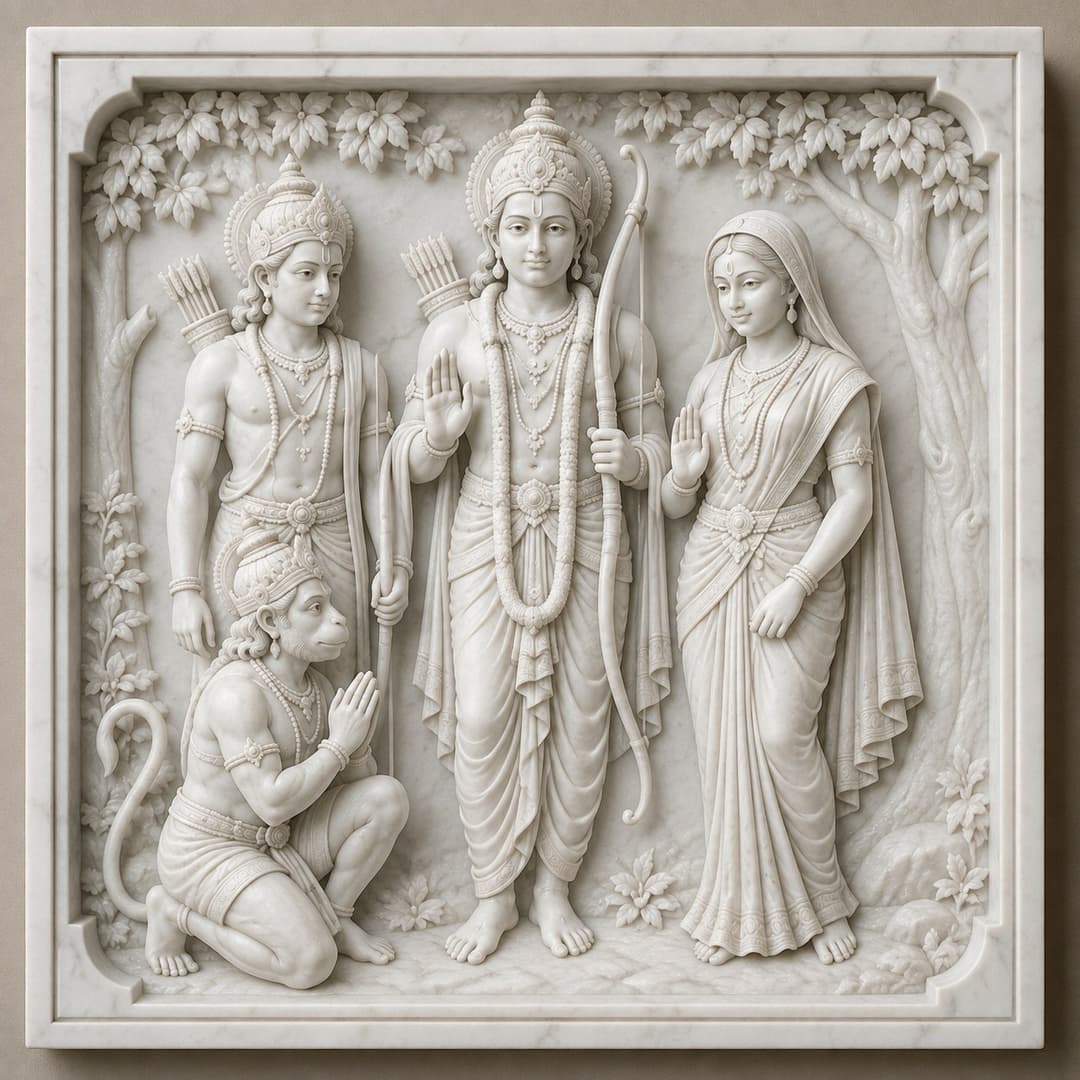
Ram Darbar
Makrana Marble ReliefRam at the centre with bow in hand, Lakshman and Sita at his sides and Hanuman kneeling in namaskar, set beneath a canopy of carved leaves.
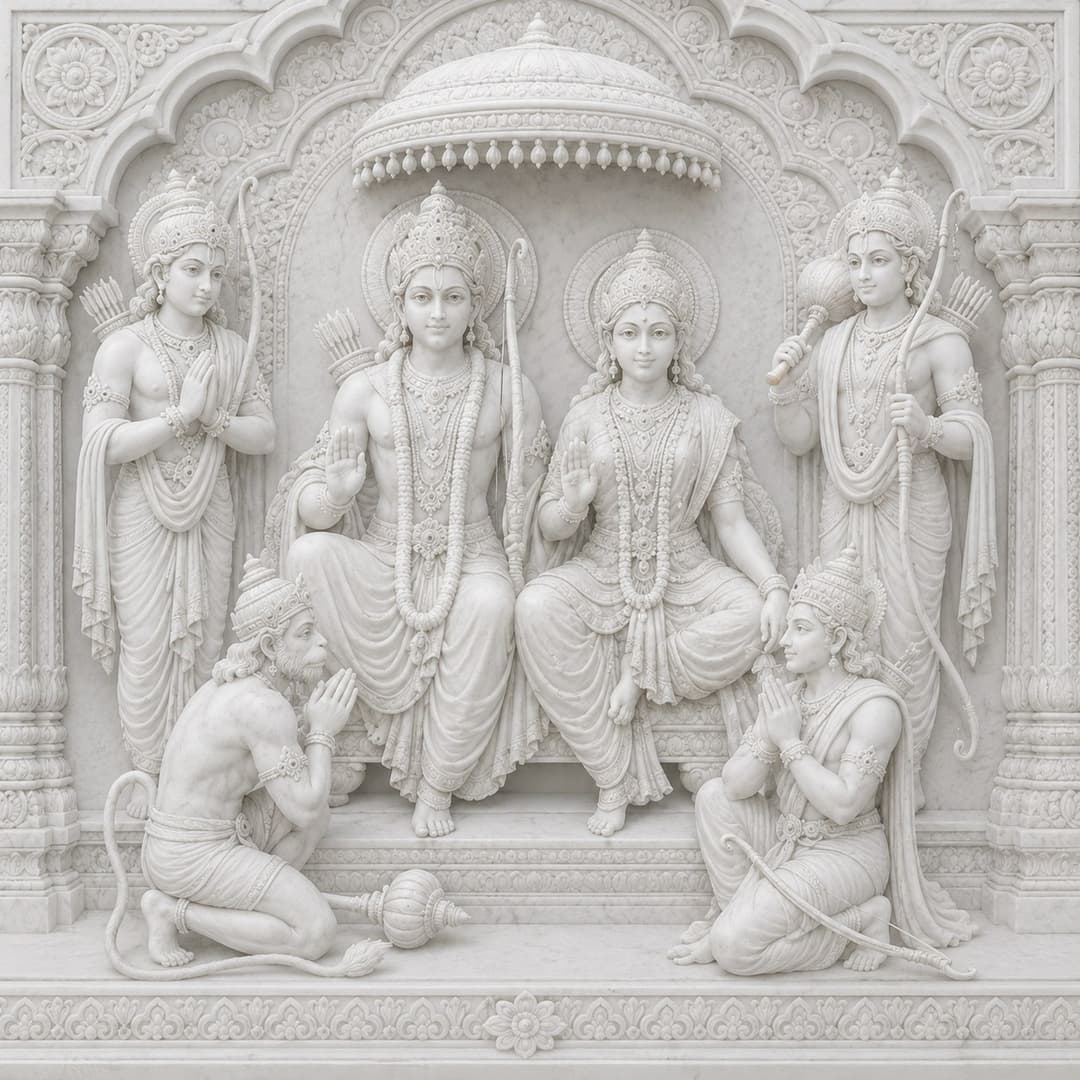
See photos & detailsSinhasan Ram Darbar
Rajasthani Marble ReliefThe full court in relief — Ram and Sita enthroned beneath a royal chhatra, the brothers standing in attendance and Hanuman bowed at their feet.
See photos & details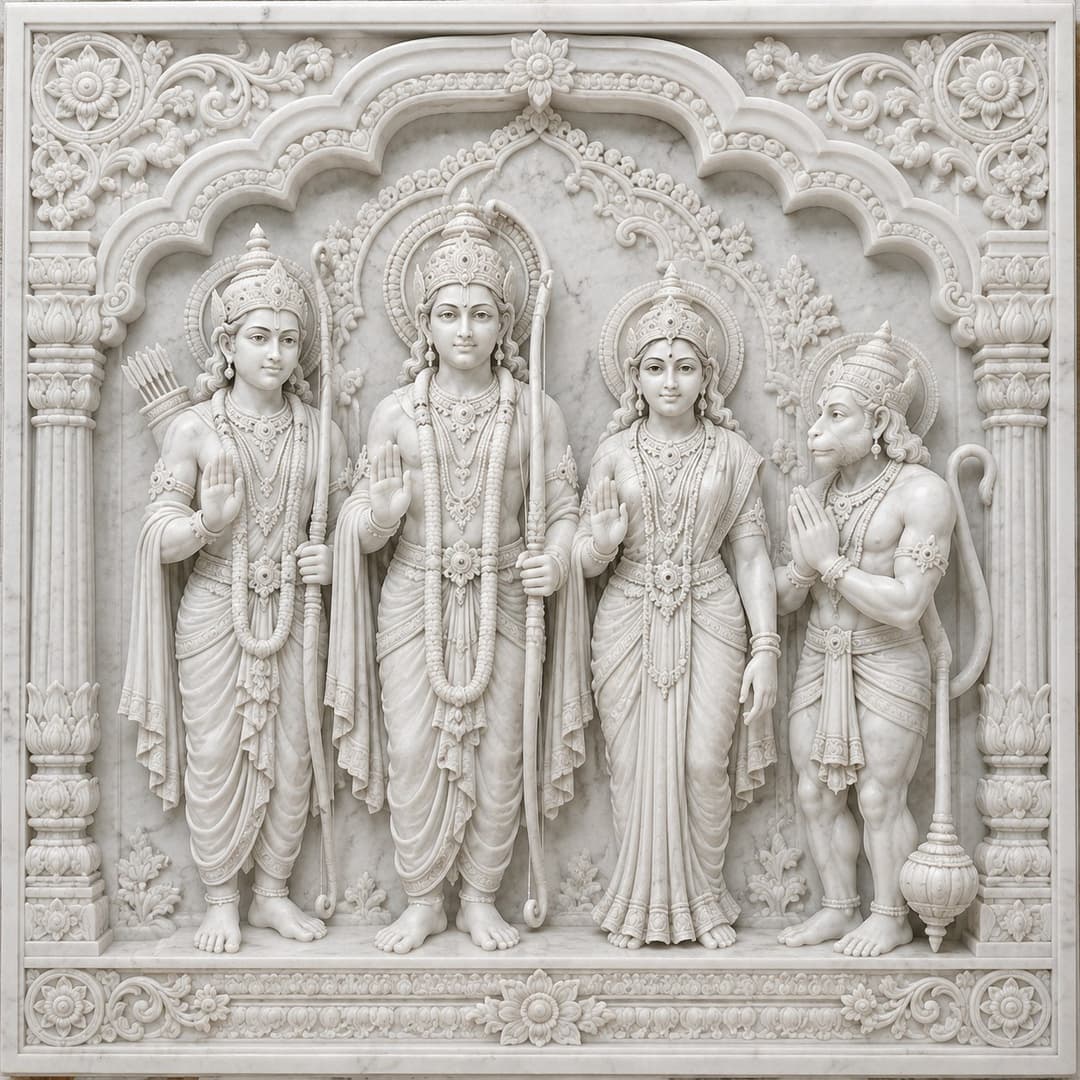
Ram Parivar
Makrana Marble ReliefLakshman, Ram, Sita and Hanuman standing together within a scalloped temple arch, each figure framed by its own carved column.
See photos & details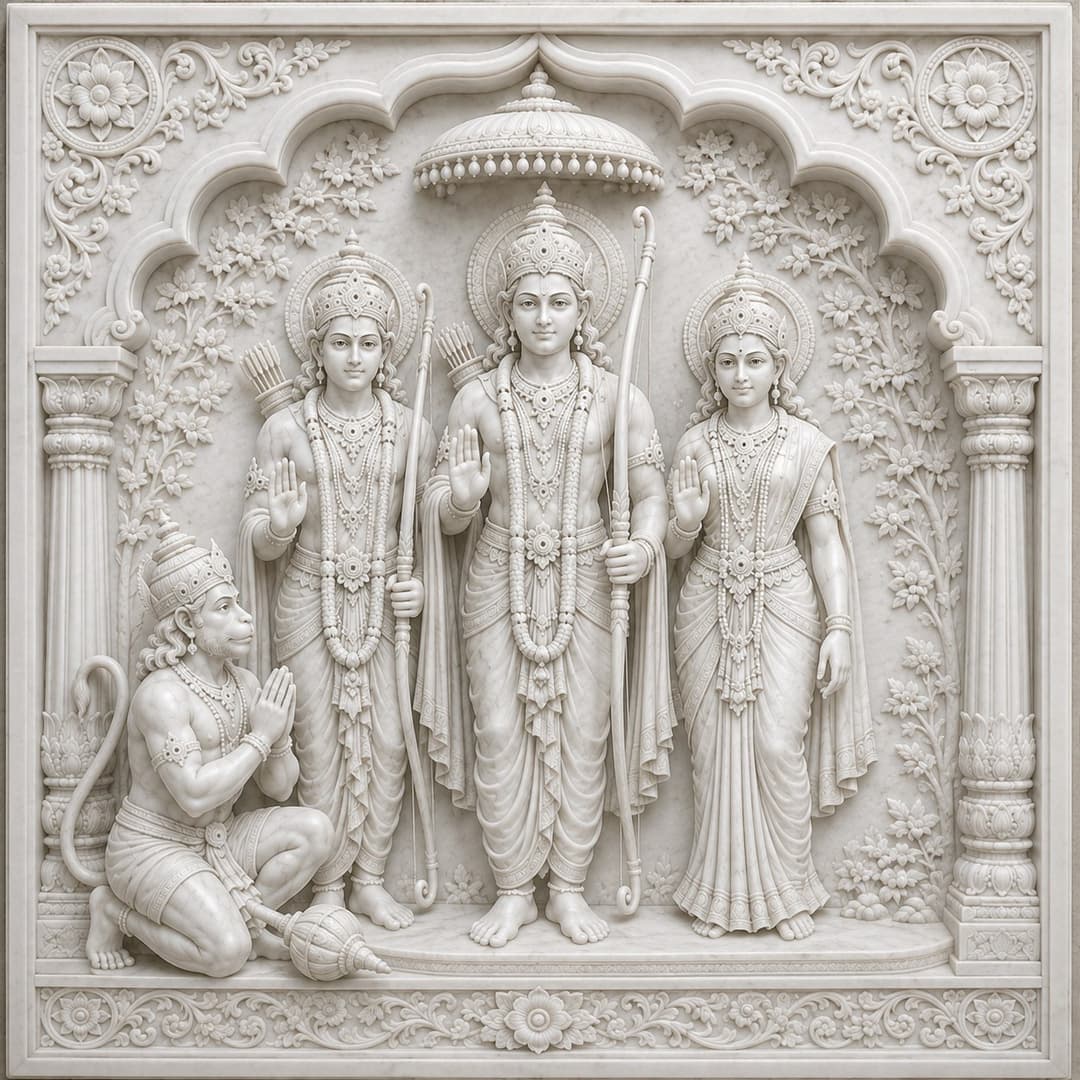
Ram Darbar with Chhatra
Makrana Marble ReliefThe family in blessing pose under a fluted parasol, foliage worked into every inch of the surrounding arch.
See photos & details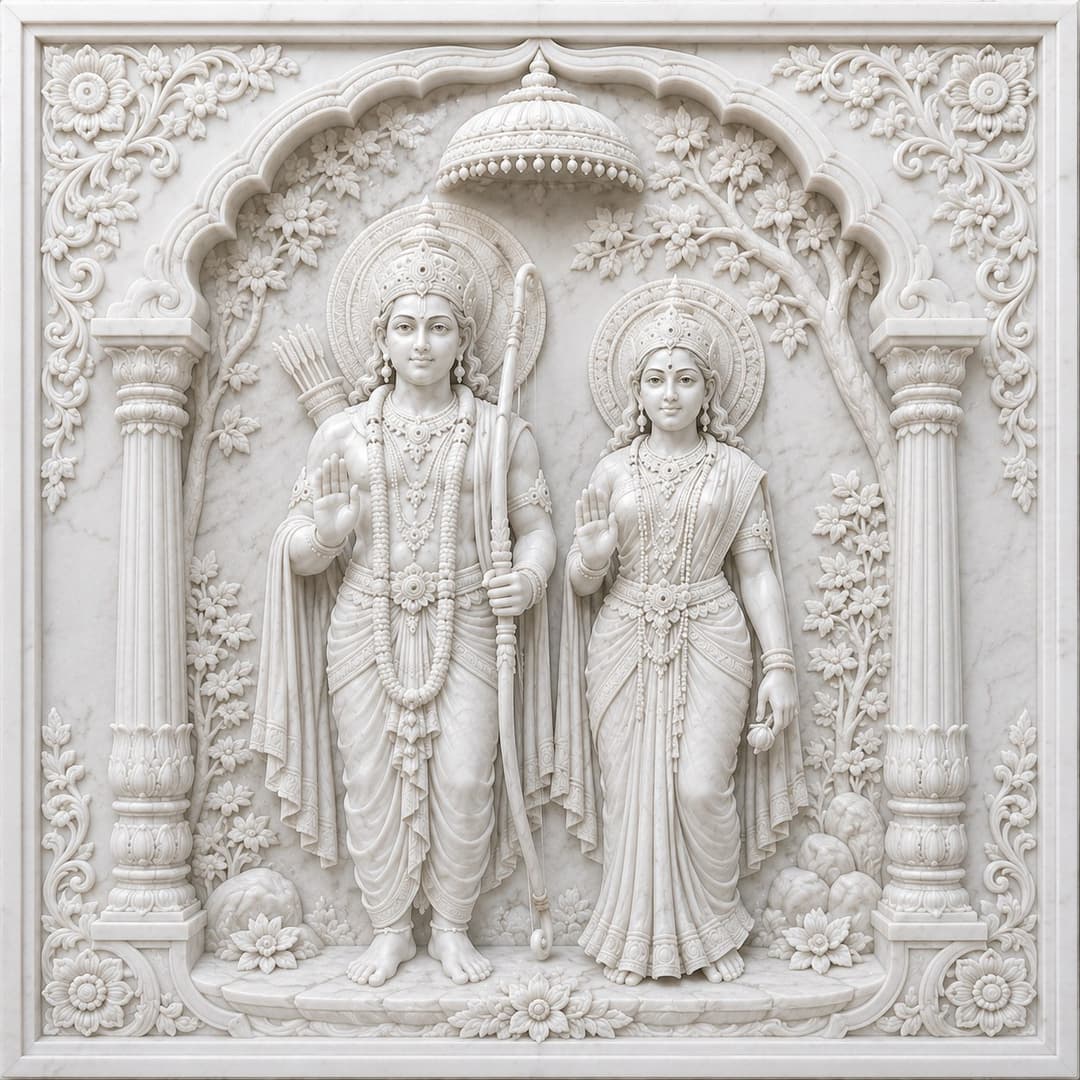
Siya Ram
Rajasthani Marble ReliefRam and Sita alone, hands raised in blessing between two carved pillars — the quietest panel in the set.
See photos & details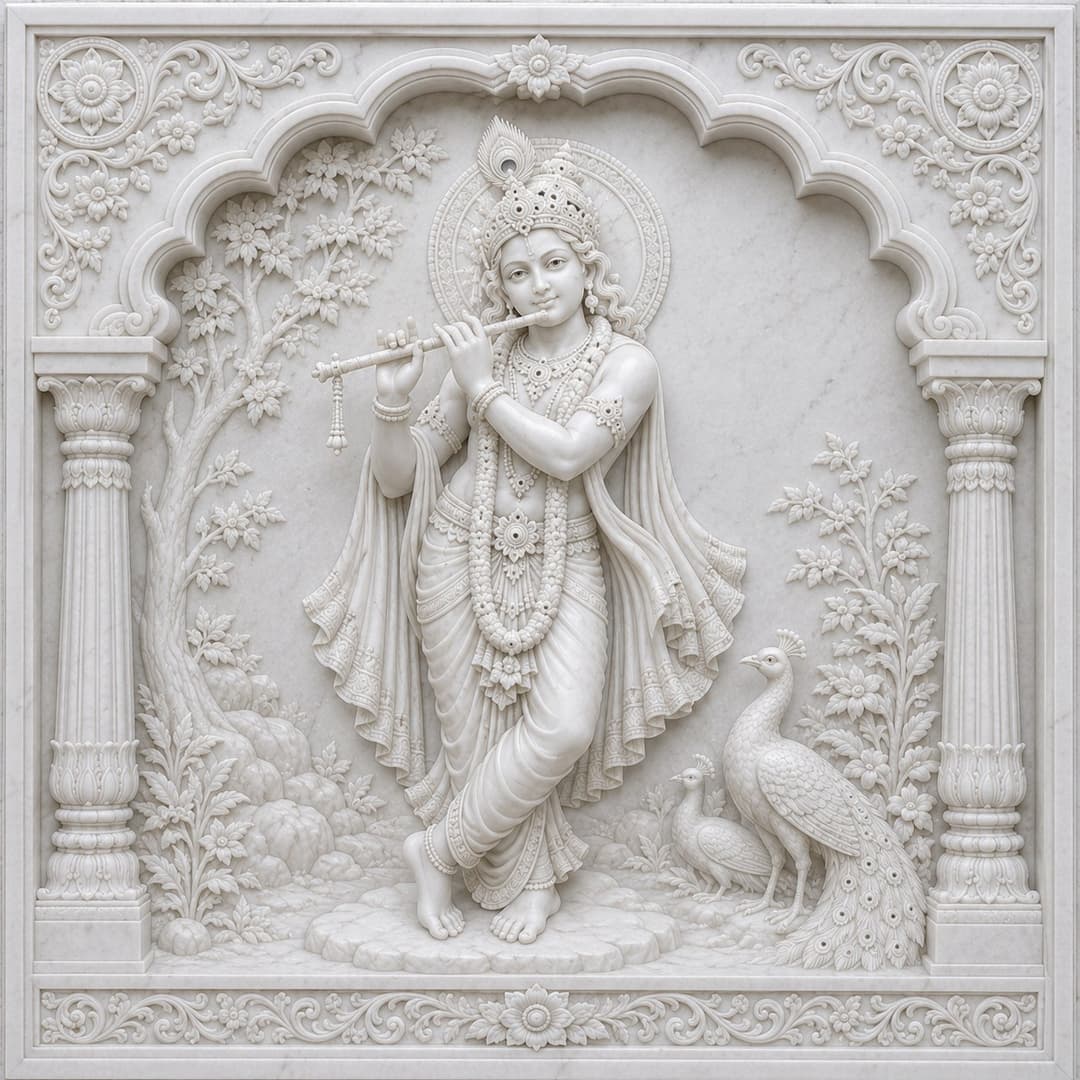
Murlidhar
Makrana Marble ReliefKrishna at the flute in tribhanga stance, peacocks gathered at his feet and a vine-worked arch closing overhead.
See photos & details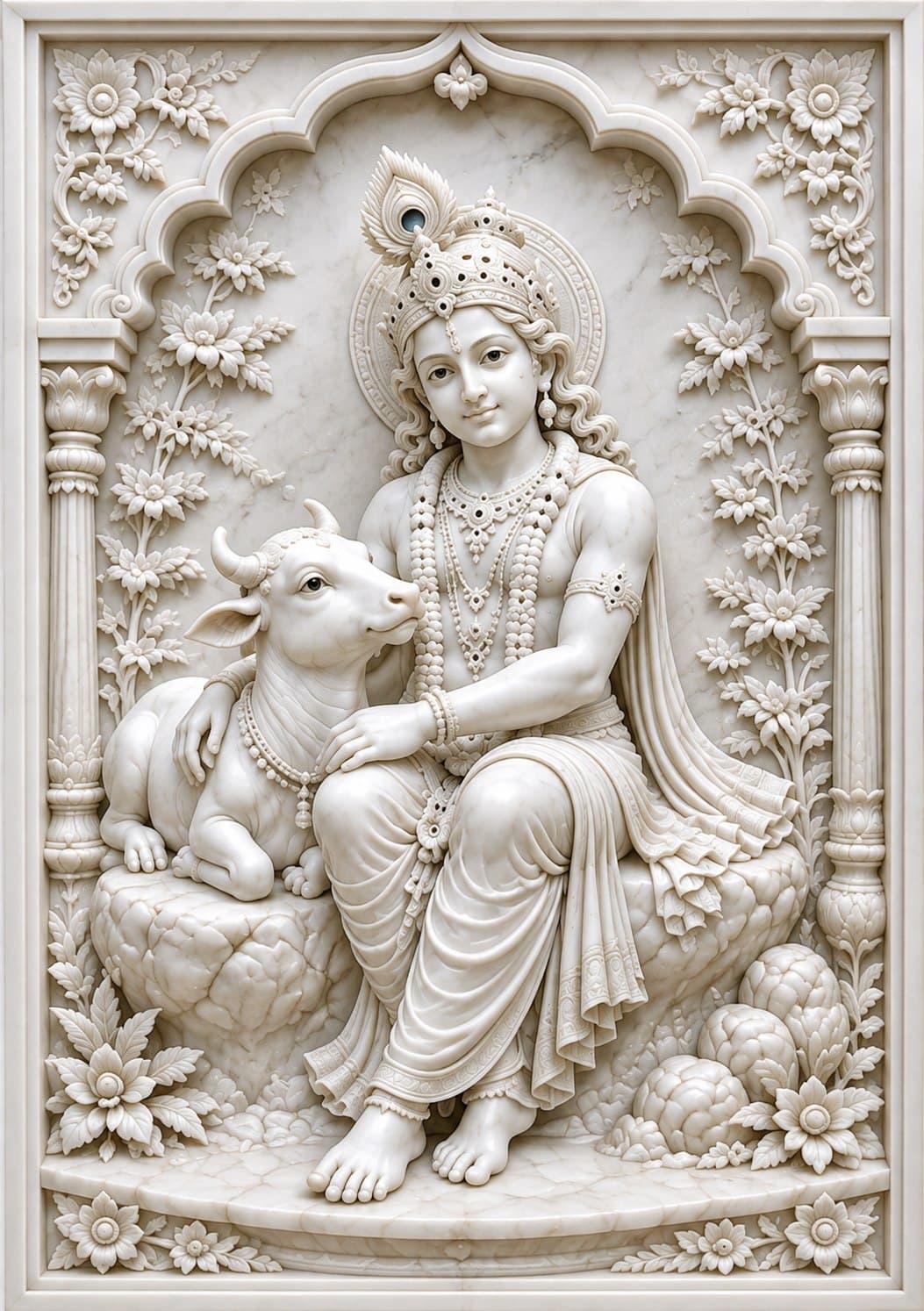
Bal Gopal
Makrana Marble ReliefThe young Krishna seated on a rock, one hand at the muzzle of a calf that has come to rest beside him.
See photos & details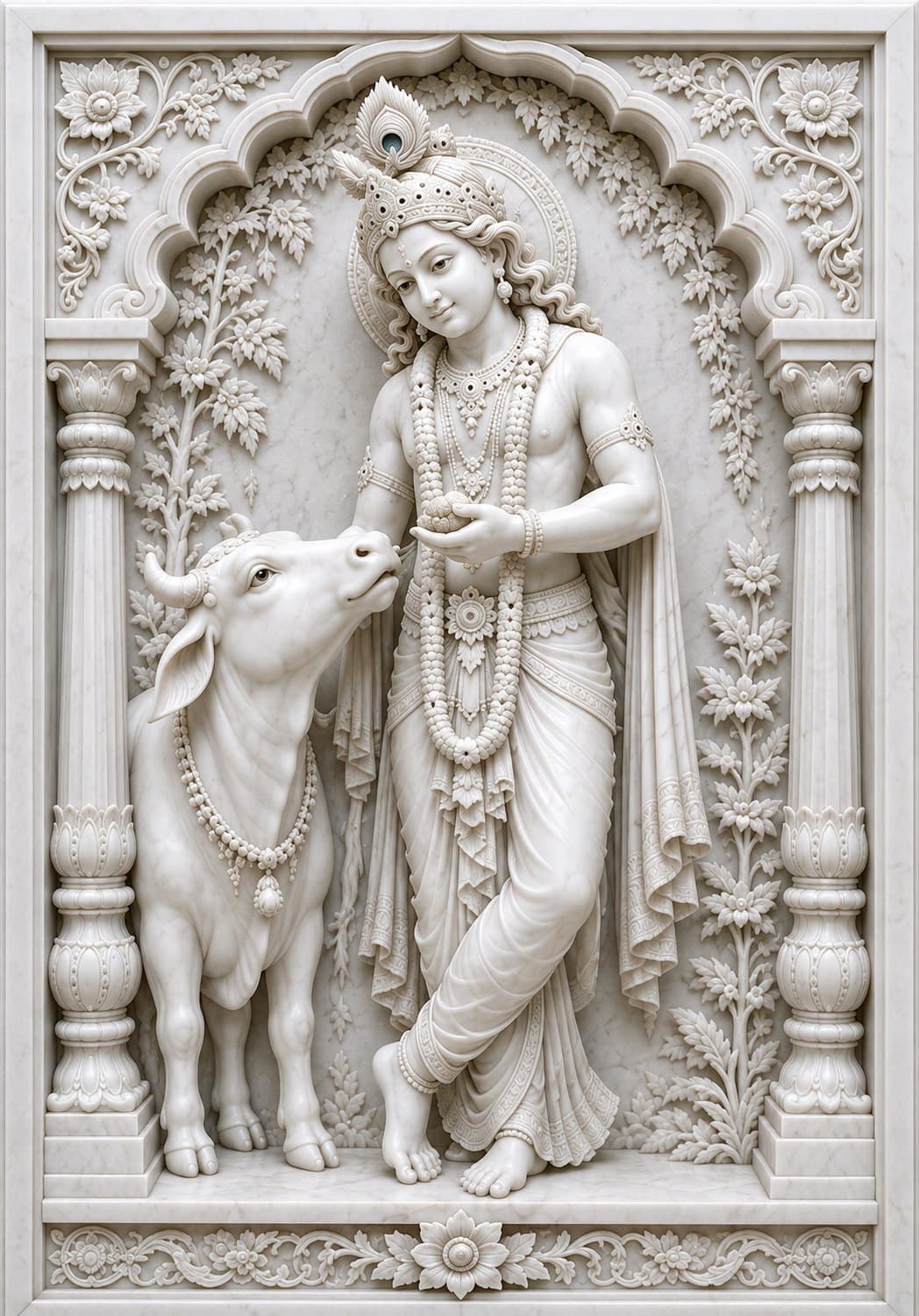
Gopal with Kamdhenu
Rajasthani Marble ReliefKrishna standing beside the garlanded cow, her head lifted to his hand — cowherd and herd carved as one unbroken line.
See photos & details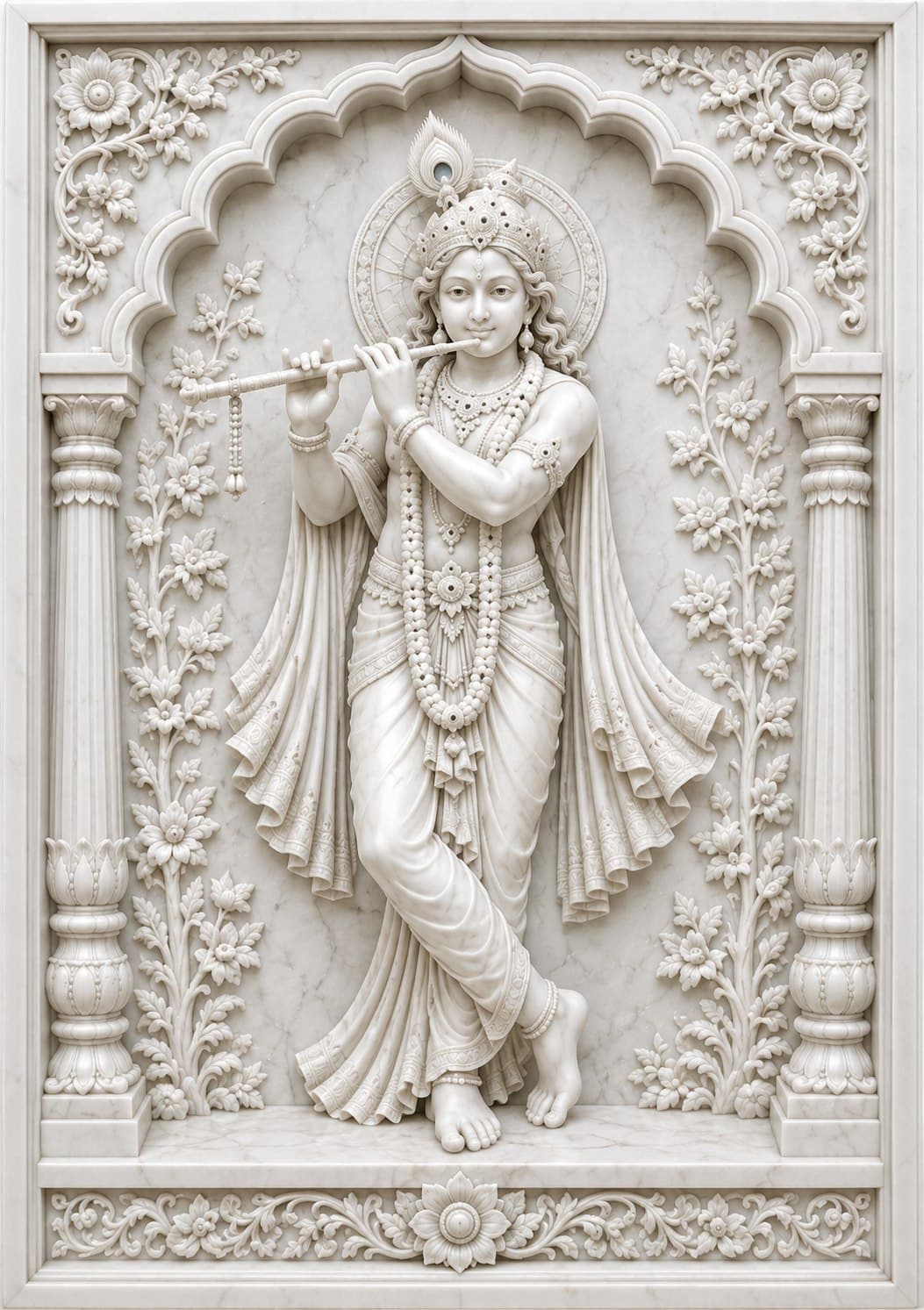
Venugopal
Makrana Marble ReliefA tall panel of Krishna at the flute, drapery falling in deep folds against a plain marble ground.
See photos & details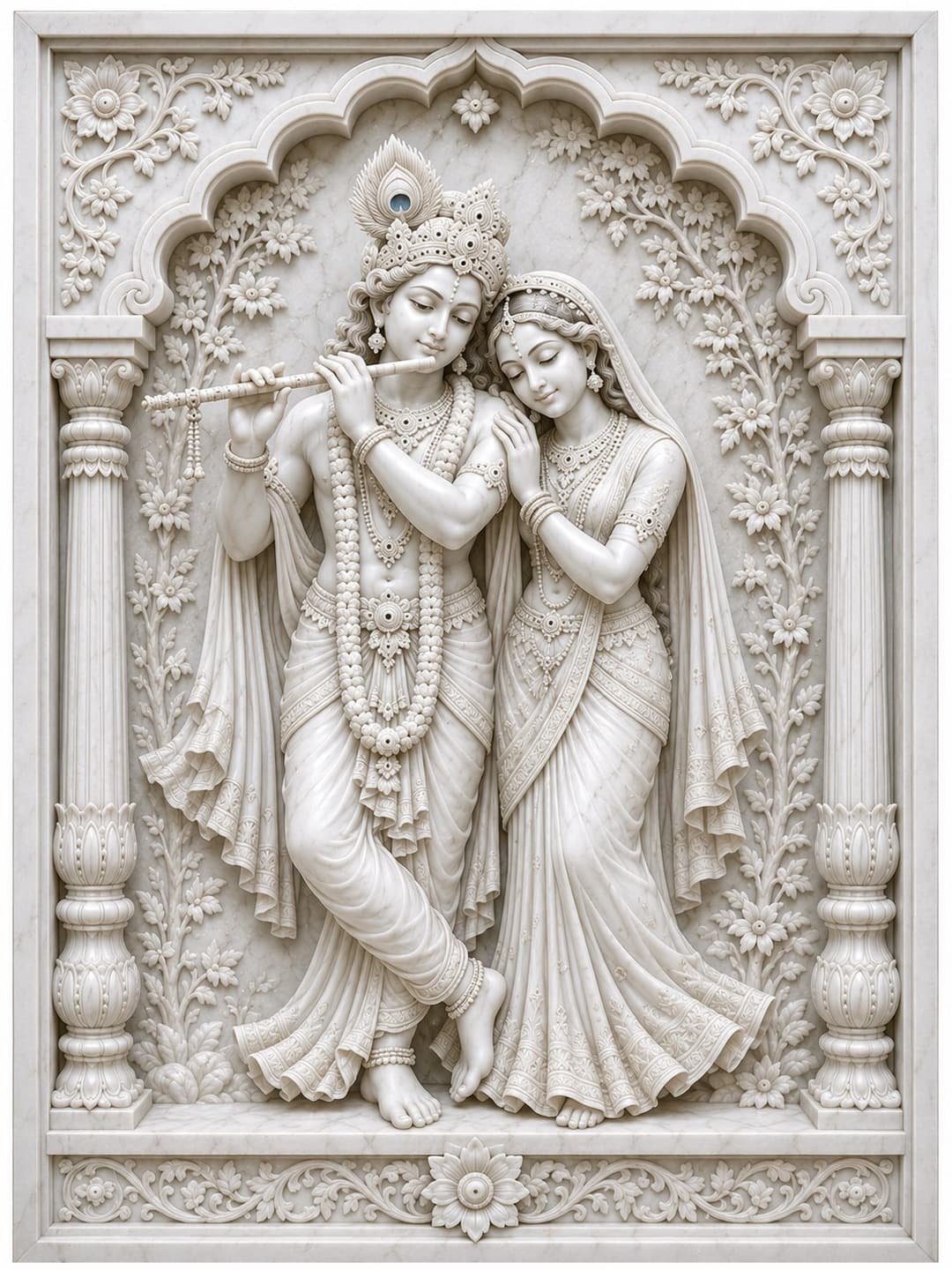
Radha Krishna
Makrana Marble ReliefRadha resting her head at Krishna’s shoulder as he plays, the two figures carved almost free of the panel behind them.
See photos & details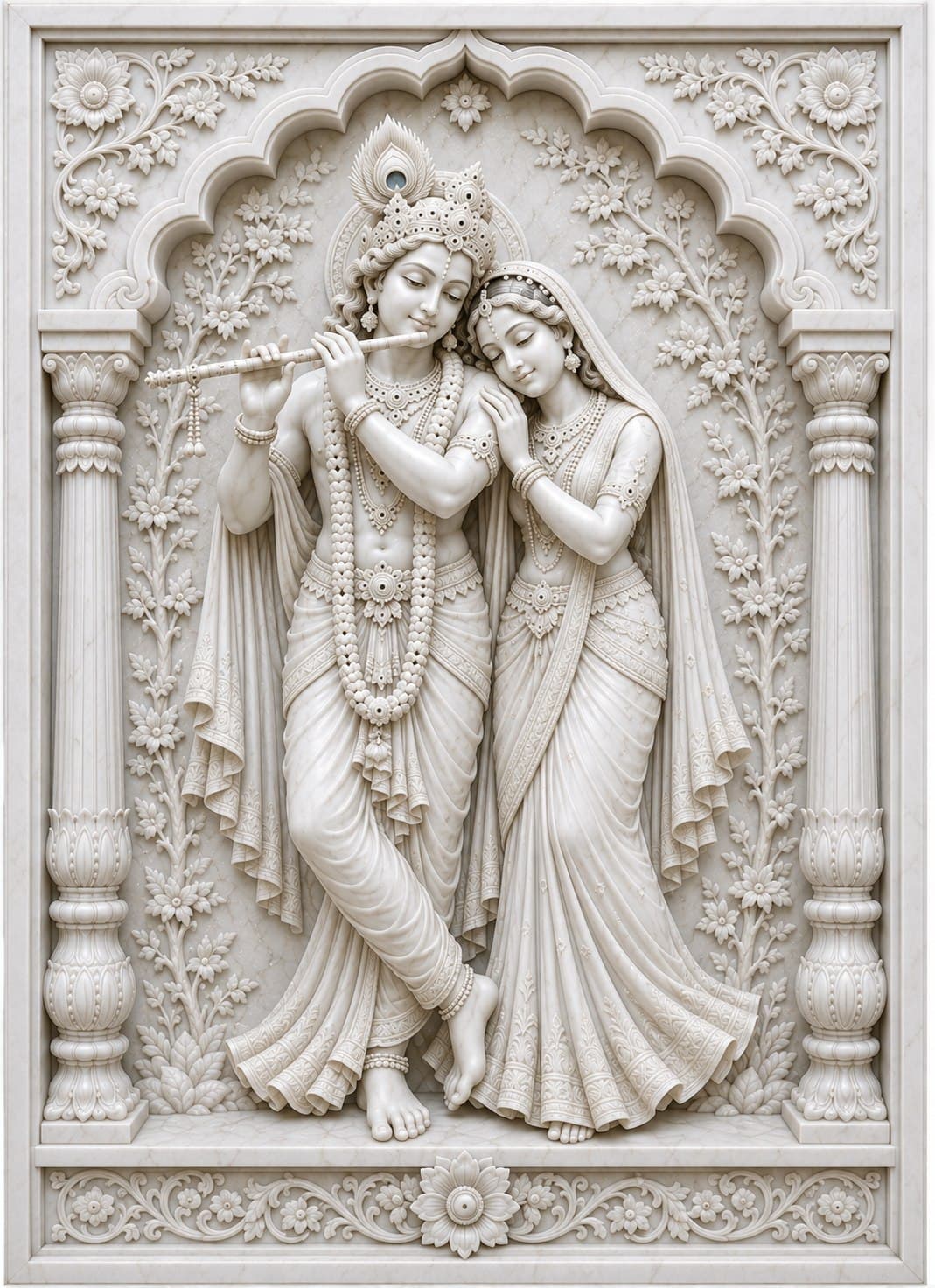
Radha Madhav
Rajasthani Marble ReliefThe divine pair beneath a flowering arch, garlands and drapery worked to the depth the marble will hold.
See photos & details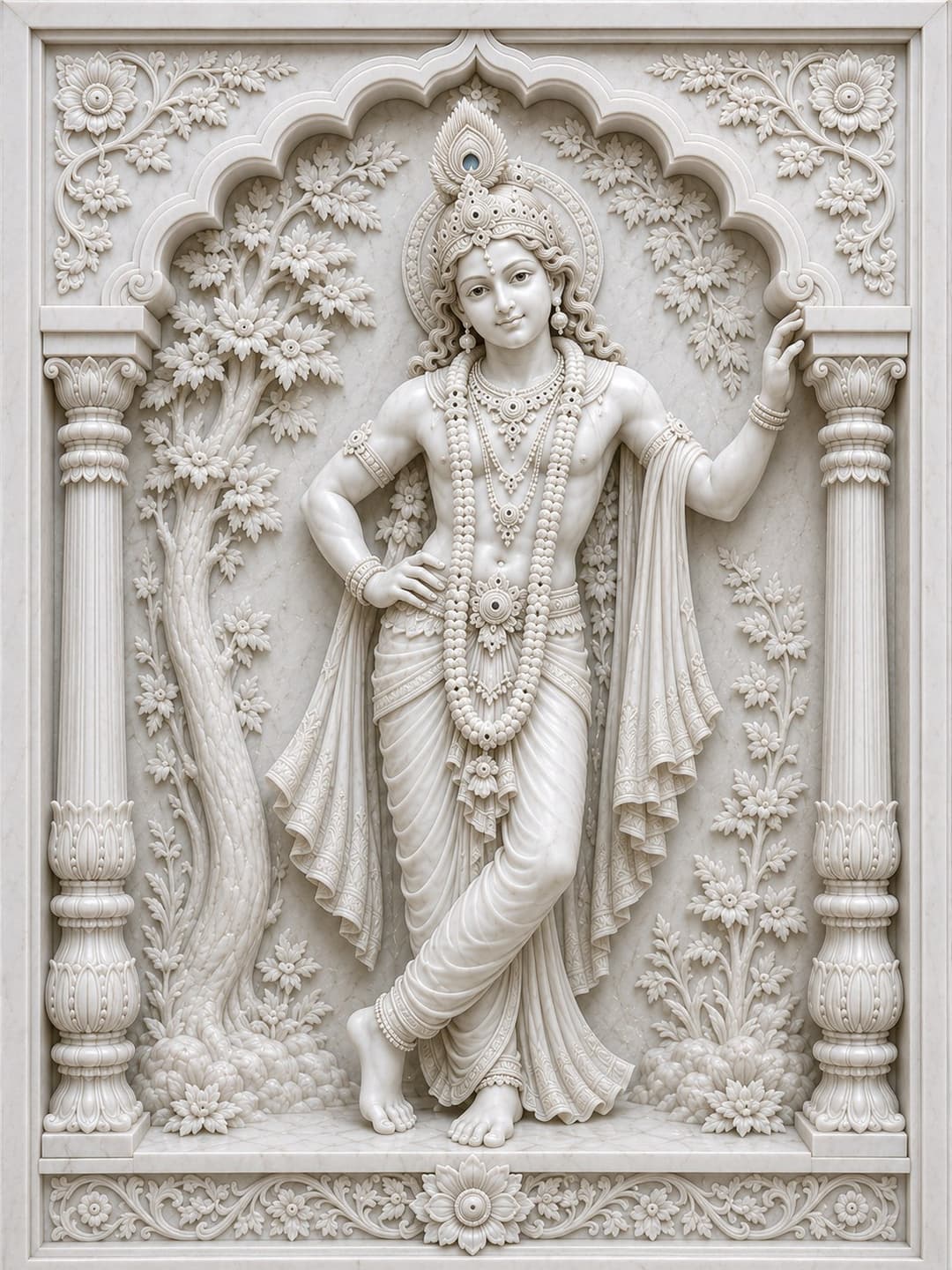
Madan Mohan
Makrana Marble ReliefKrishna standing alone in a crowned, peacock-feathered profile, one arm raised against a carved tree.
See photos & details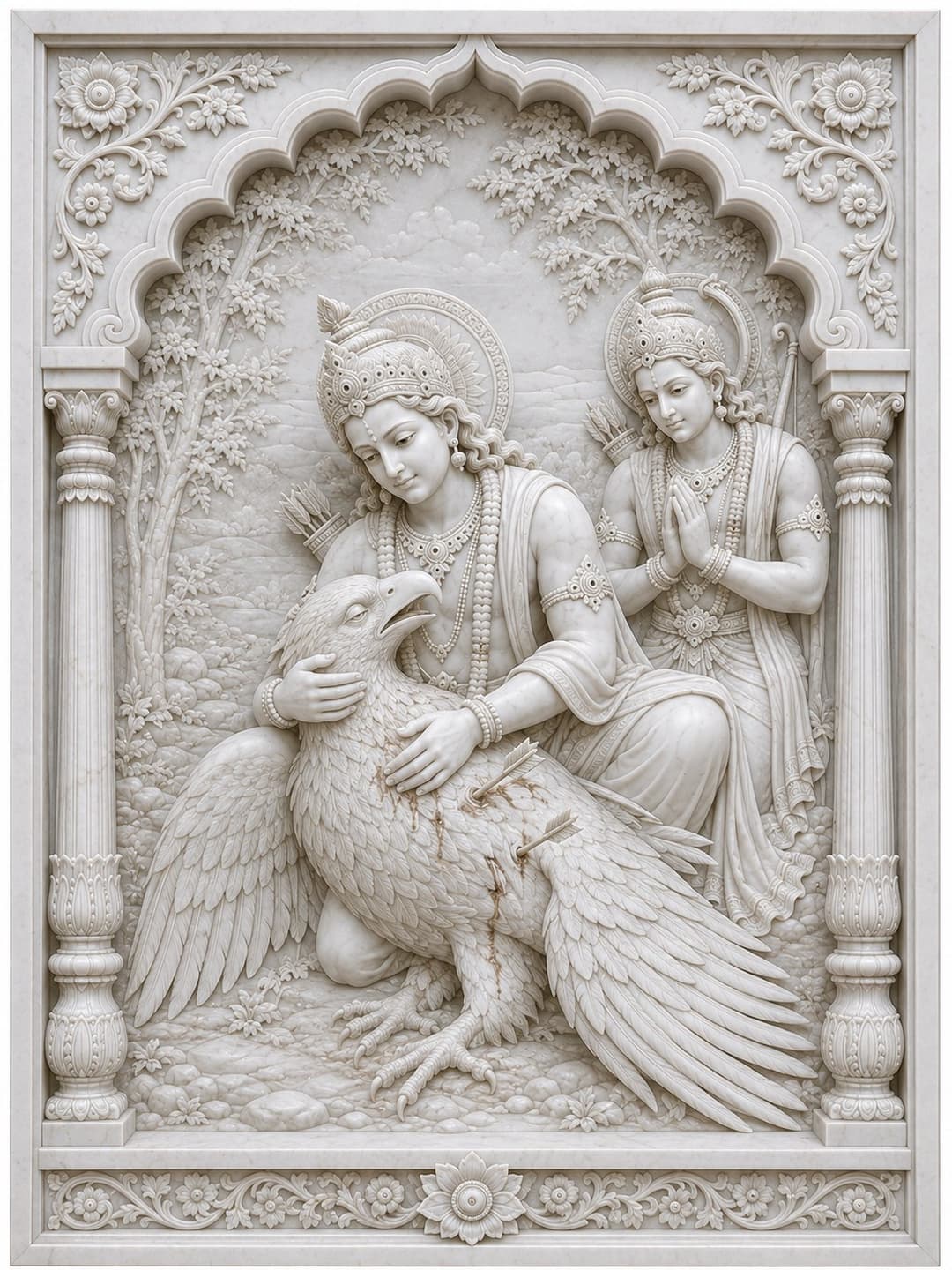
Jatayu Moksha
Makrana Marble ReliefRam cradling the wounded Jatayu as Lakshman kneels behind — every feather of the great bird cut individually.
See photos & details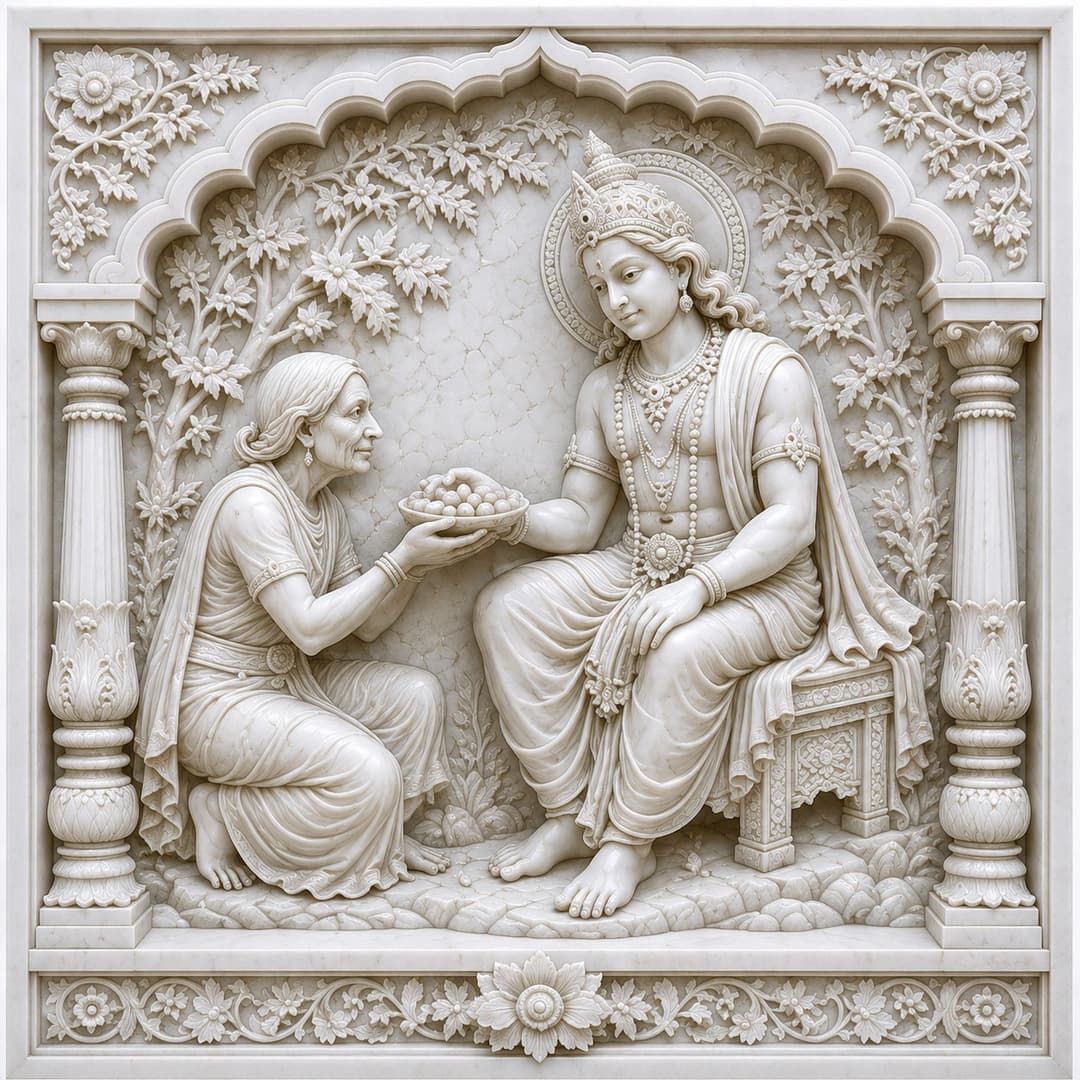
Shabari ke Ber
Rajasthani Marble ReliefShabari offering her berries to the seated Ram, the whole exchange held in two pairs of hands.
See photos & details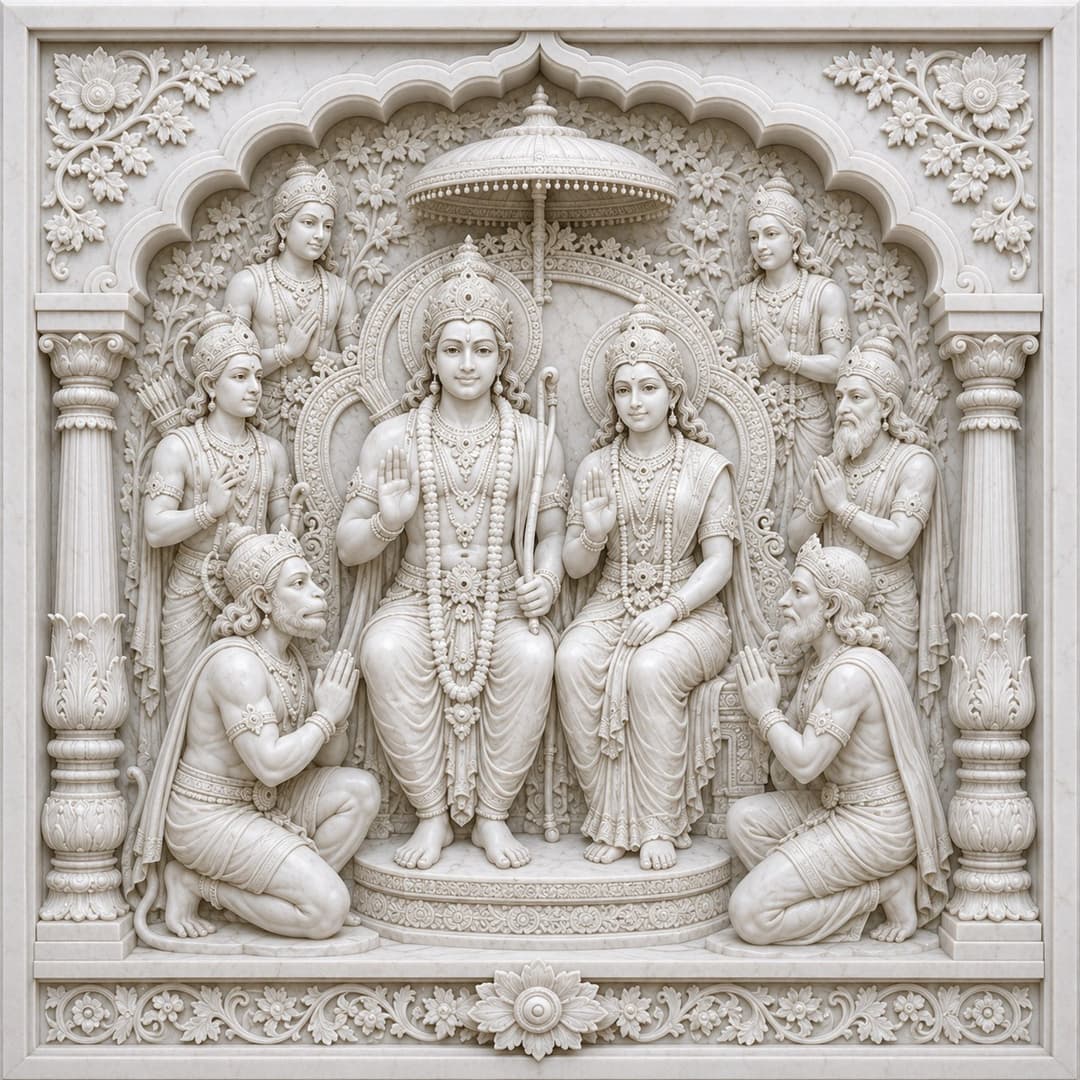
Ram Rajyabhishek
Makrana Marble ReliefThe coronation court — Ram and Sita enthroned, brothers and sages ranged around them, Hanuman at the step below.
See photos & details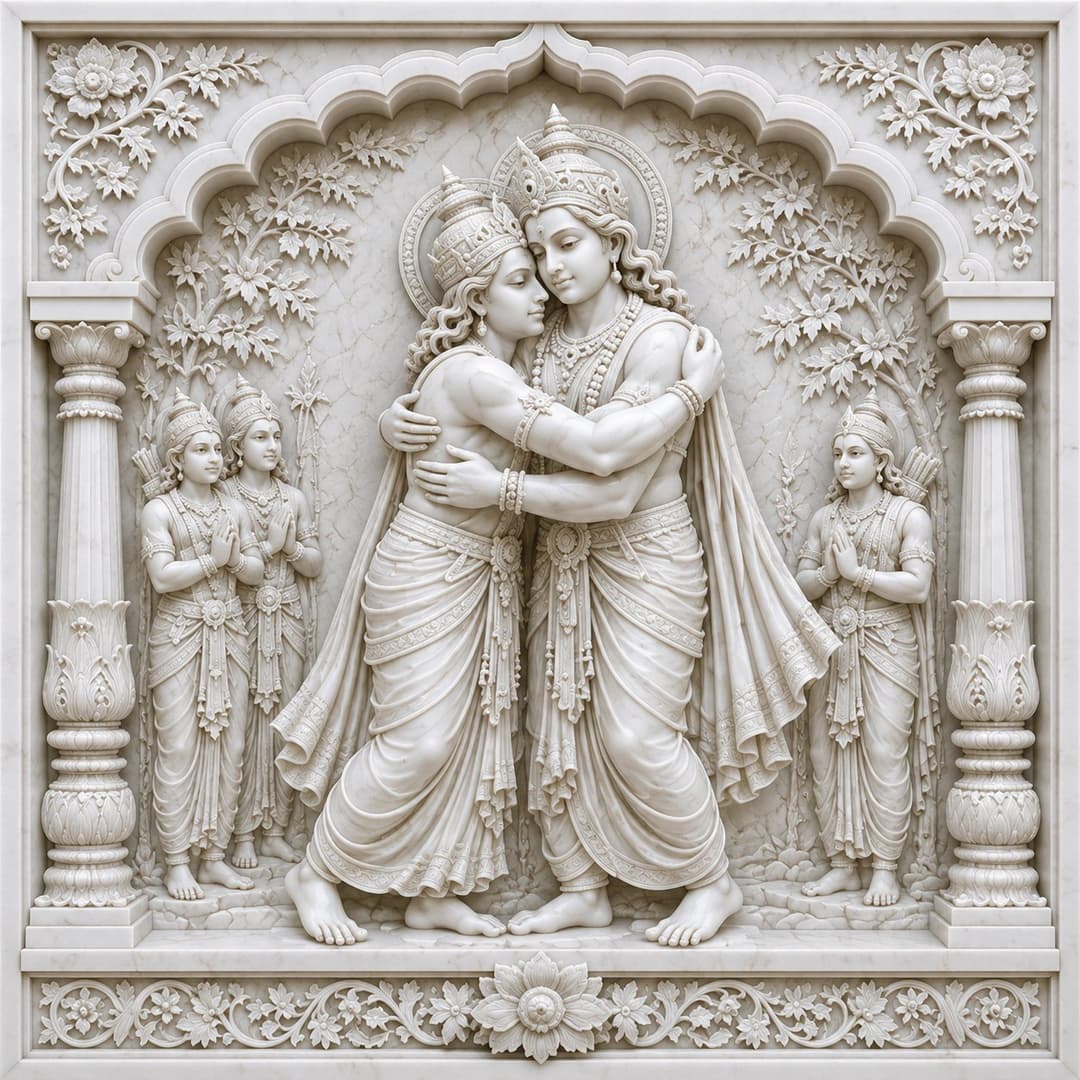
Bharat Milap
Makrana Marble ReliefThe reunion at Nandigram, Ram and Bharat locked in an embrace while the others stand back to watch.
See photos & details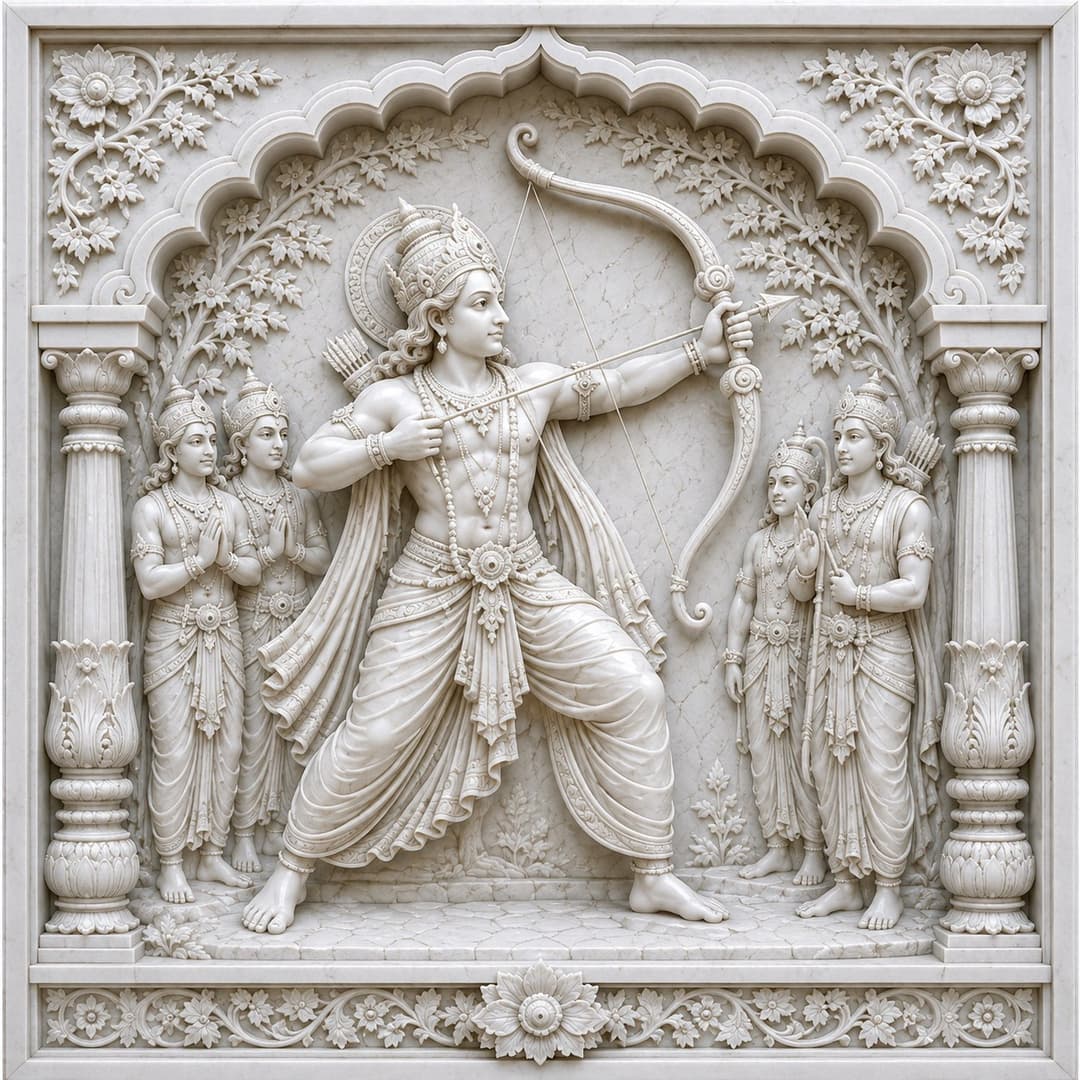
Kodanda Ram
Rajasthani Marble ReliefRam at full draw, the bow arched clear of the panel and the vanar host looking on from either side.
See photos & details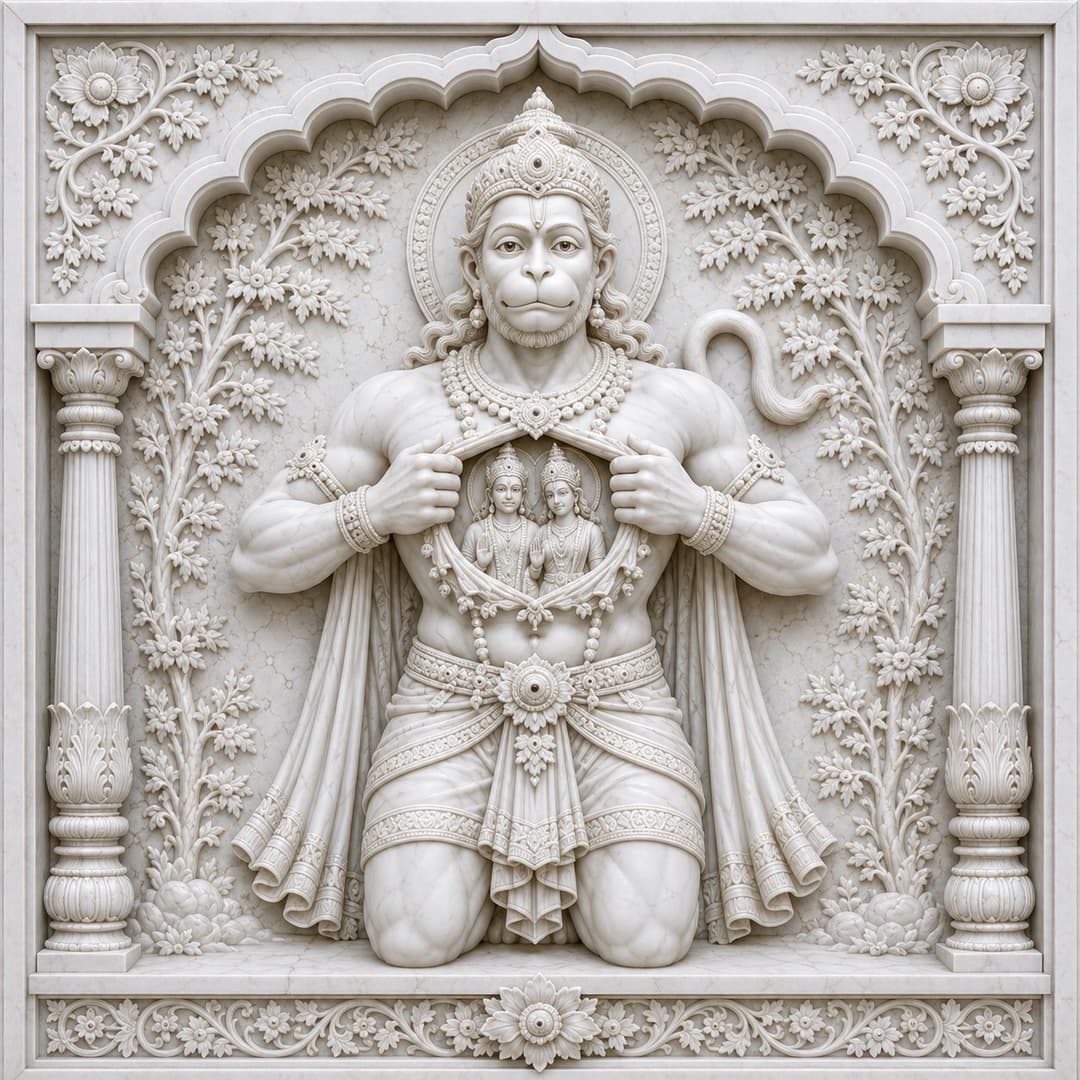
Hanuman Hriday Darshan
Makrana Marble ReliefHanuman parting his chest to reveal Ram and Sita seated within — a relief inside a relief.
See photos & details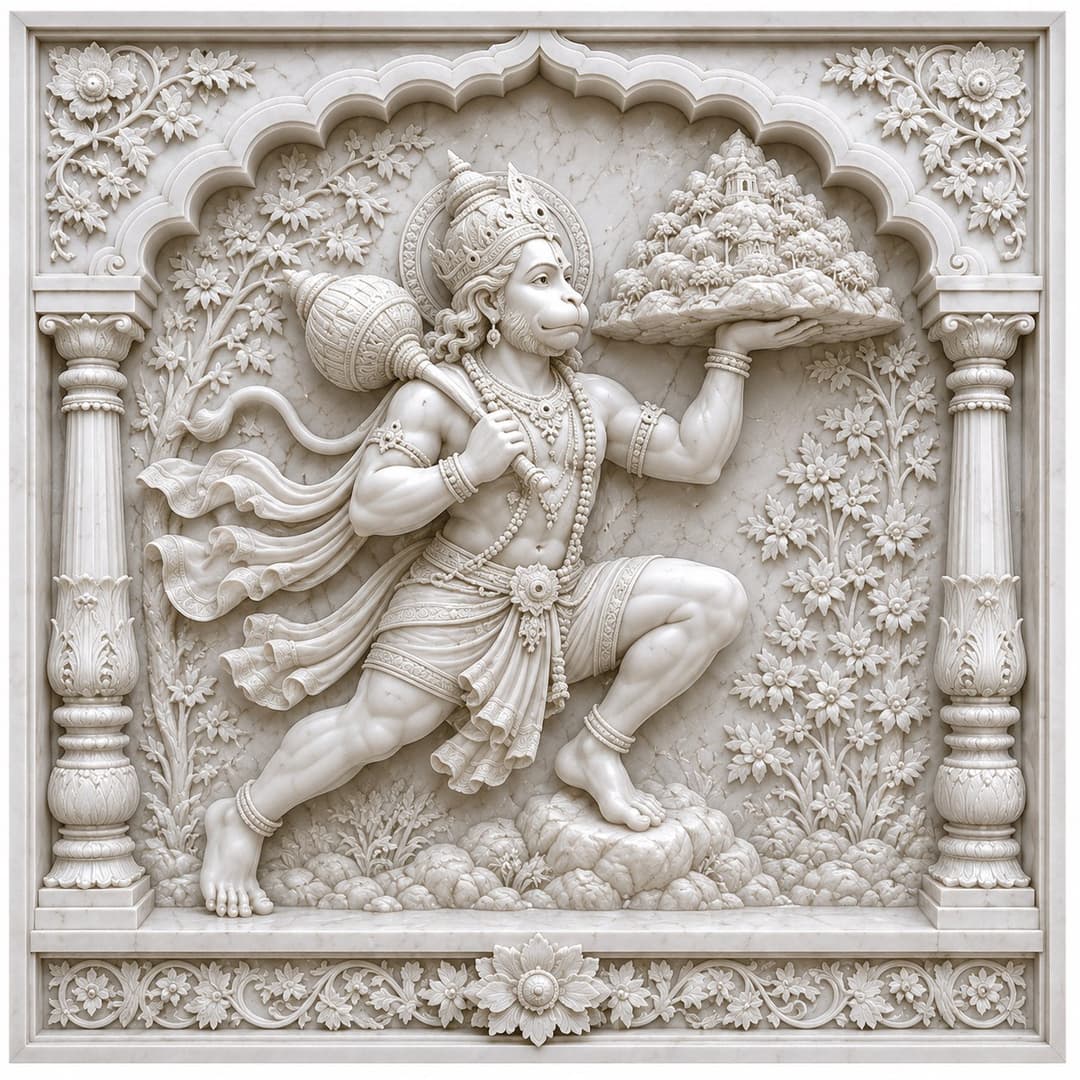
Sanjeevani Hanuman
Makrana Marble ReliefHanuman mid-flight with the mountain raised on one palm and mace on the other, cloak streaming behind him.
See photos & details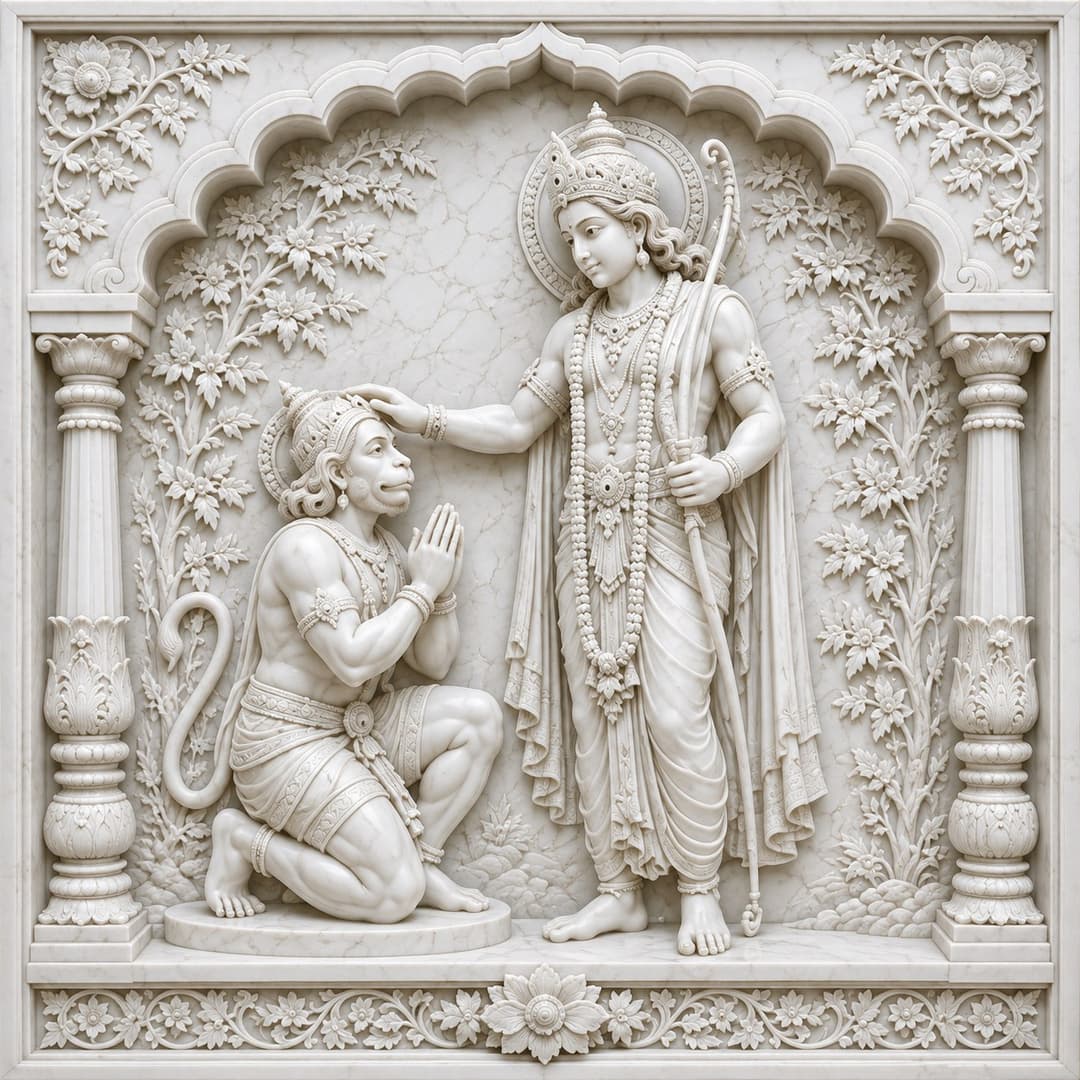
Ram Kripa
Rajasthani Marble ReliefRam’s hand resting on the head of a kneeling Hanuman — the moment of blessing, and nothing else in the frame.
See photos & details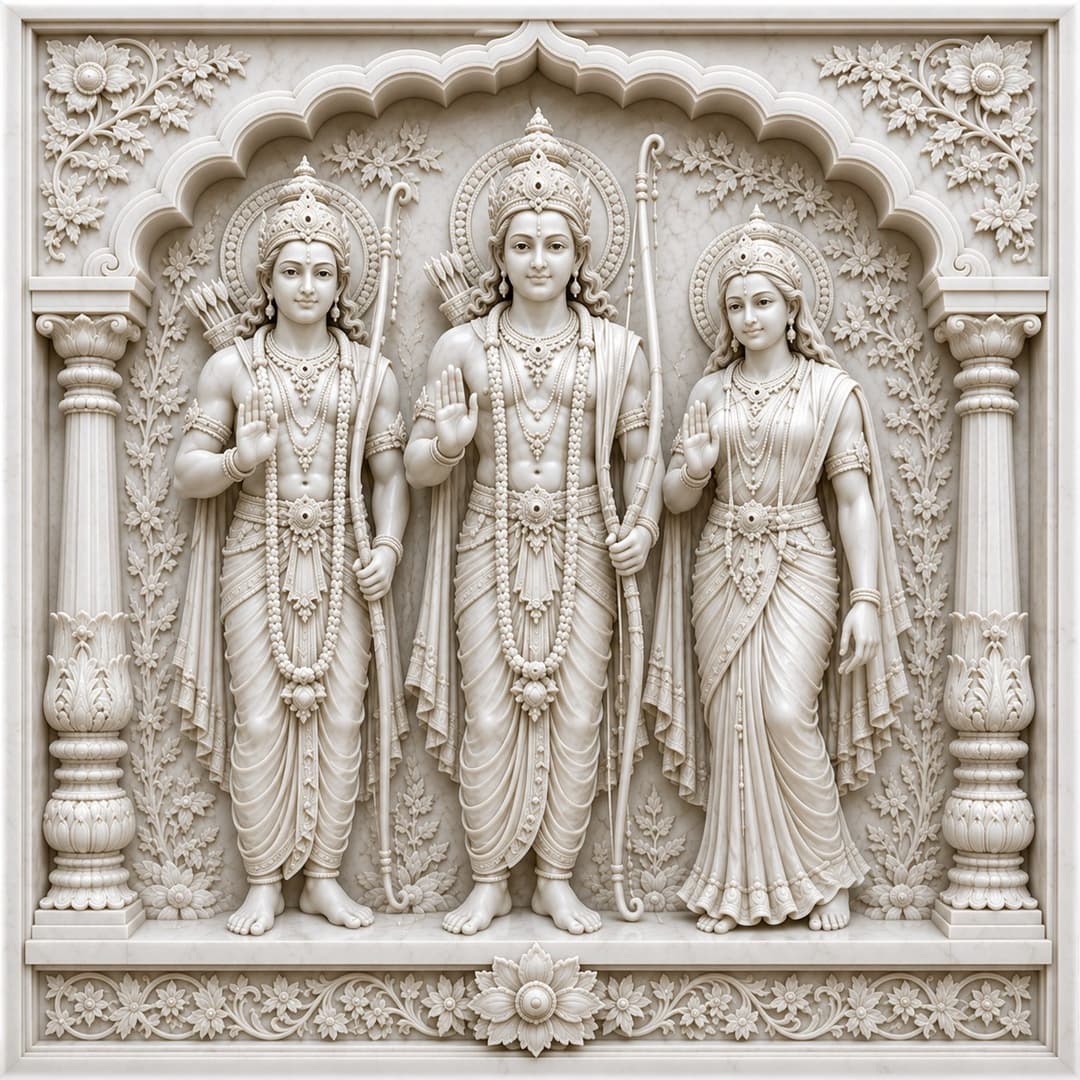
Ram Lakshman Janaki
Makrana Marble ReliefThe three standing figures in raised relief, bow and quiver carved with the same care as the faces.
See photos & details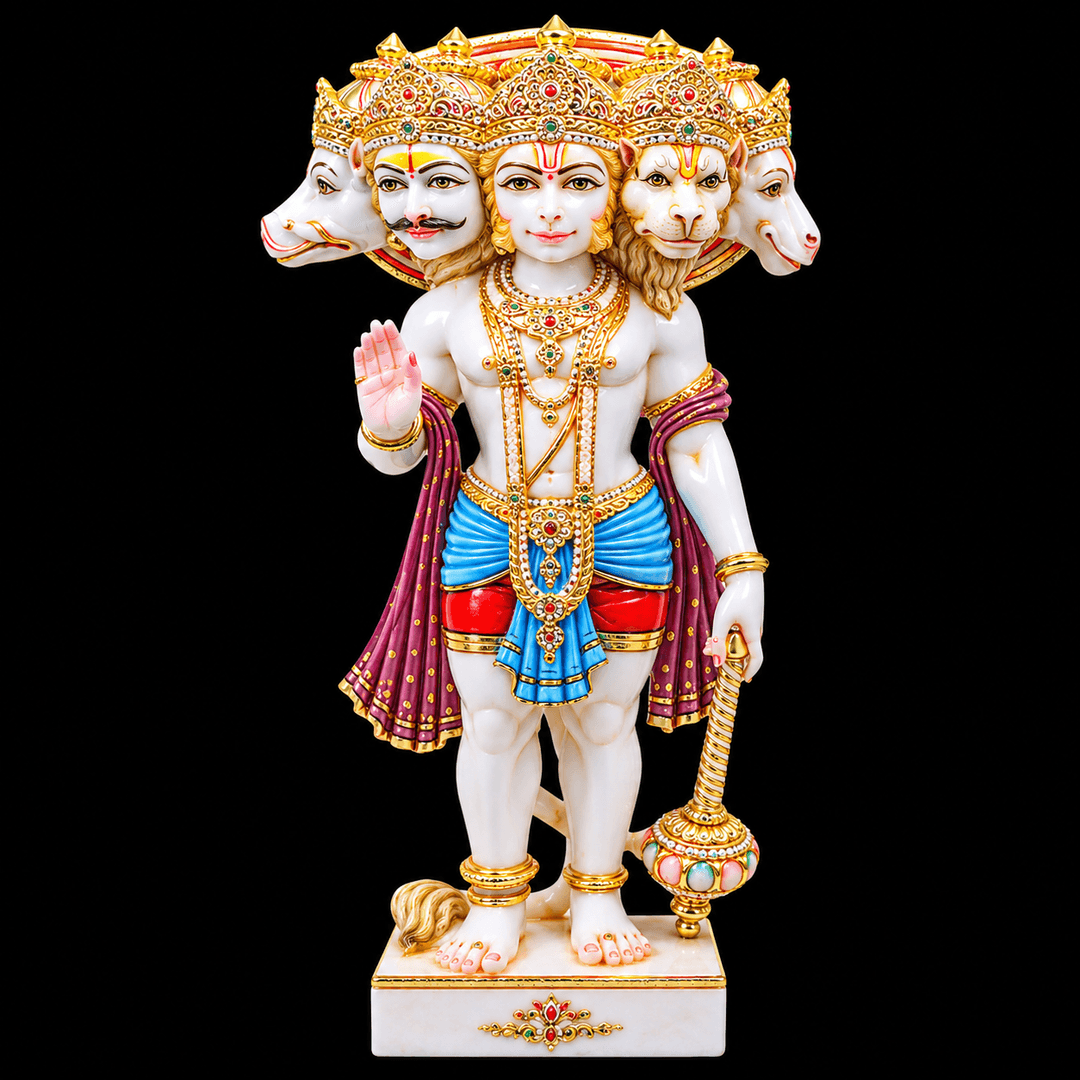
Jeweled Marble Statue of Lord Dattatreya
Makrana MarbleSee photos & details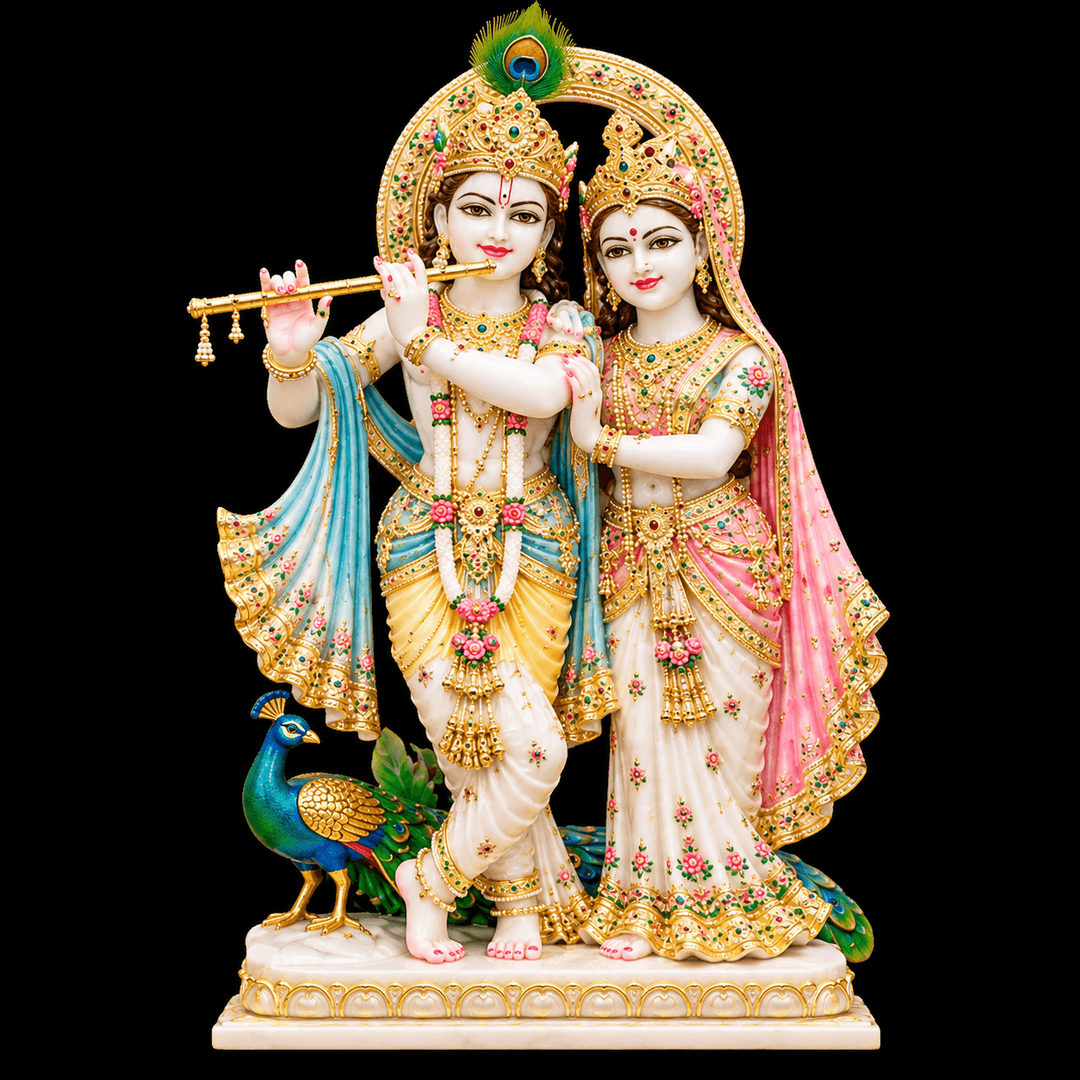
Krishna and Radha with Peacock
Makrana MarbleSee photos & details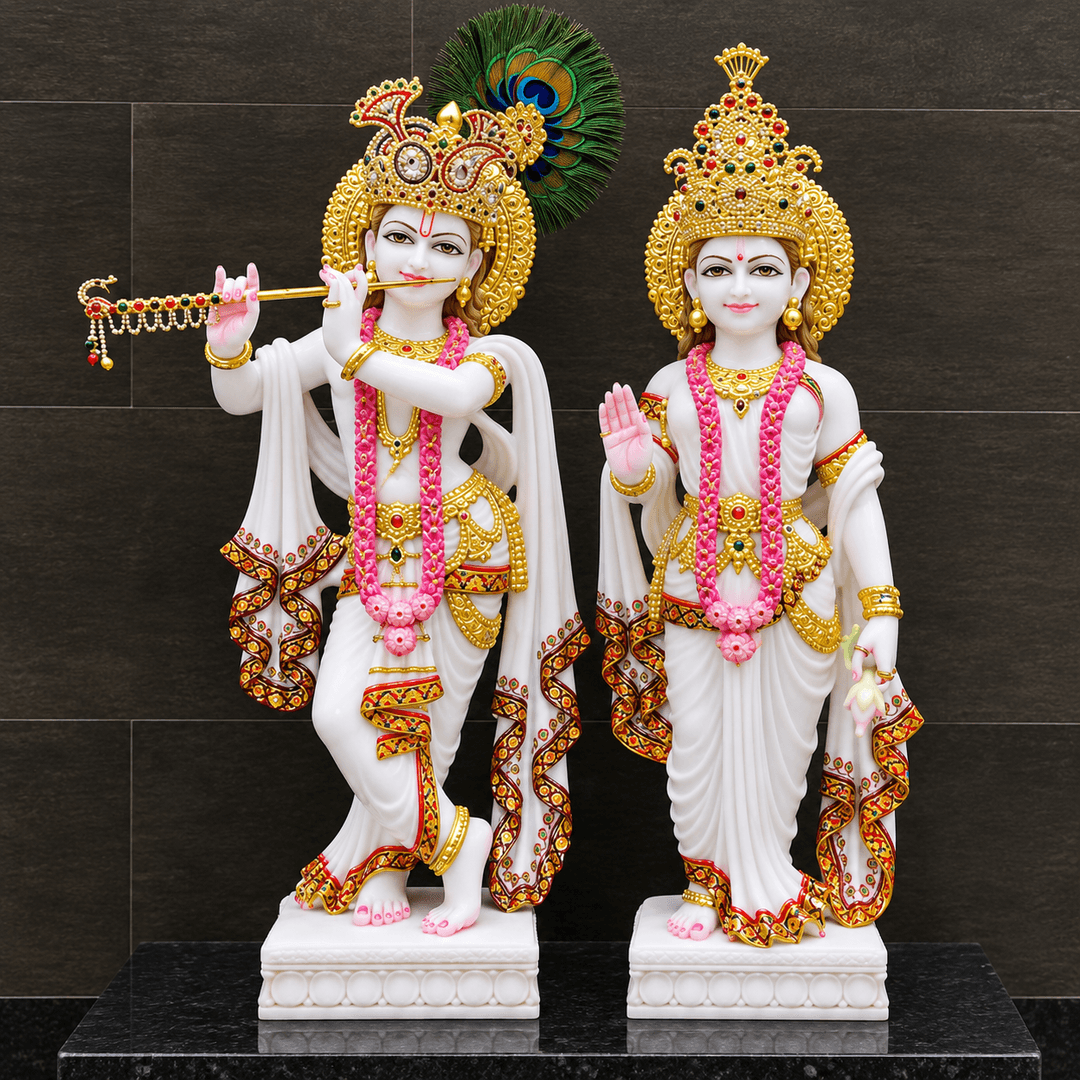
Krishna and Rama Marble Deities
Makrana MarbleSee photos & details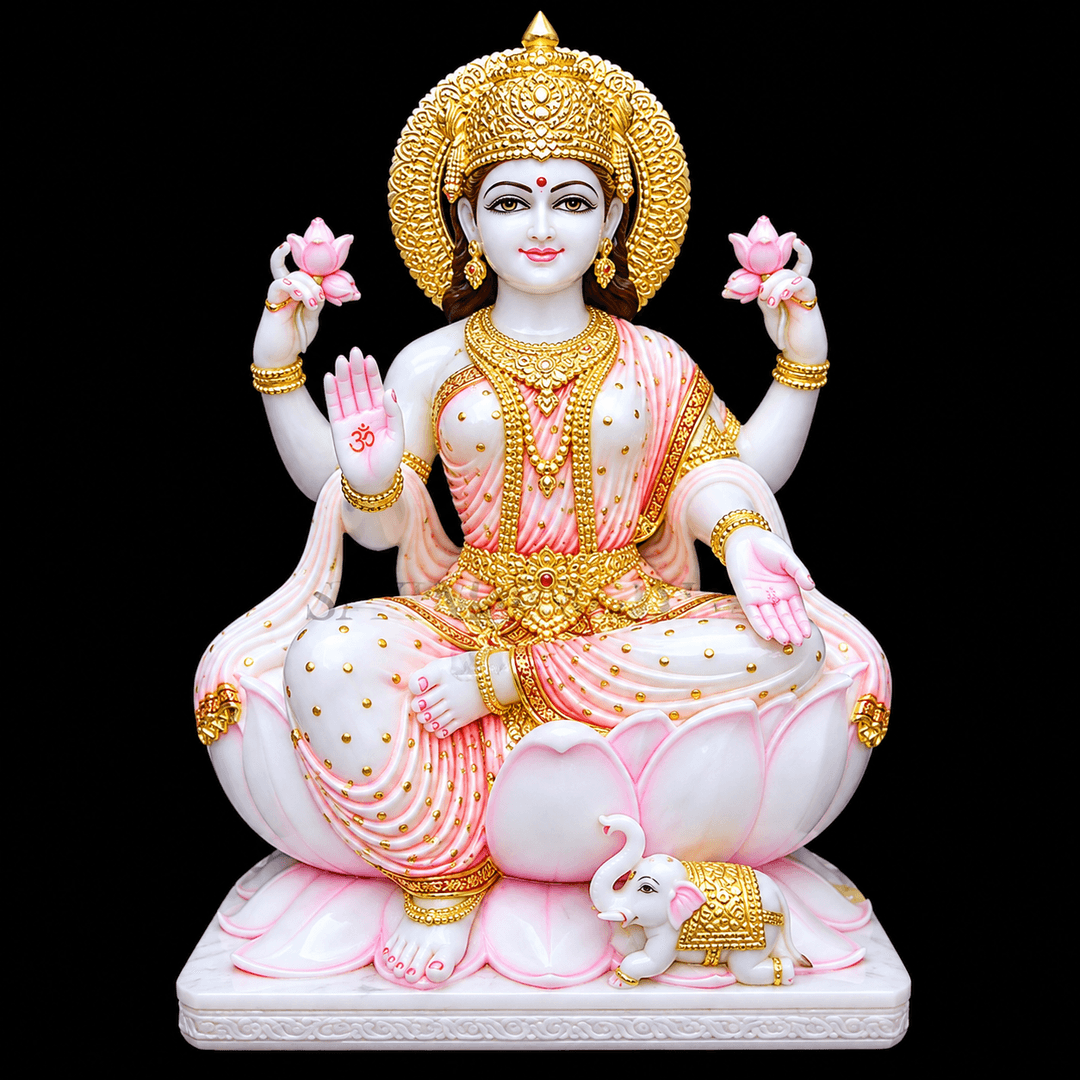
Lakshmi Marble Idol on Lotus Throne
Makrana MarbleSee photos & details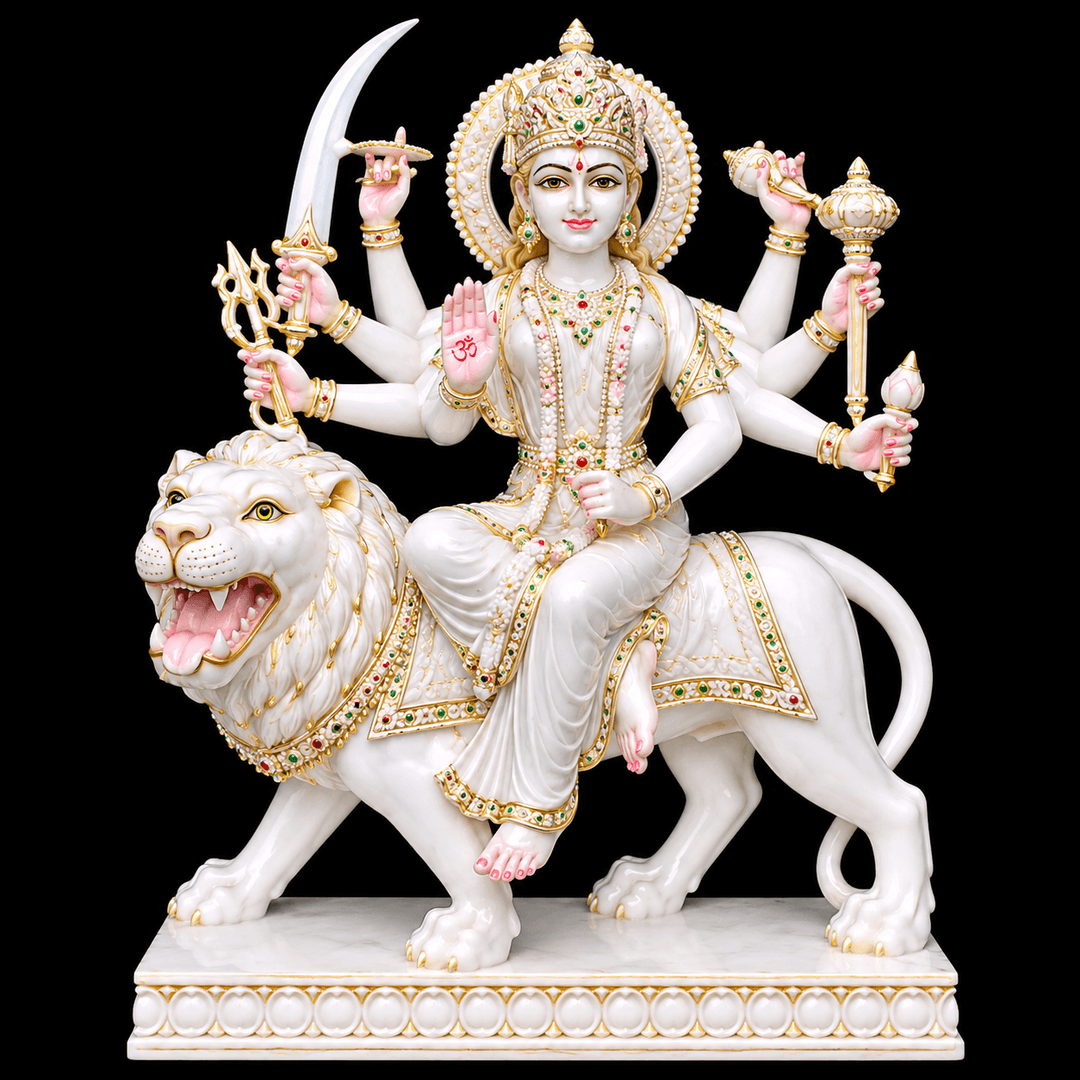
Marble Durga Statue on Lion
Makrana MarbleSee photos & details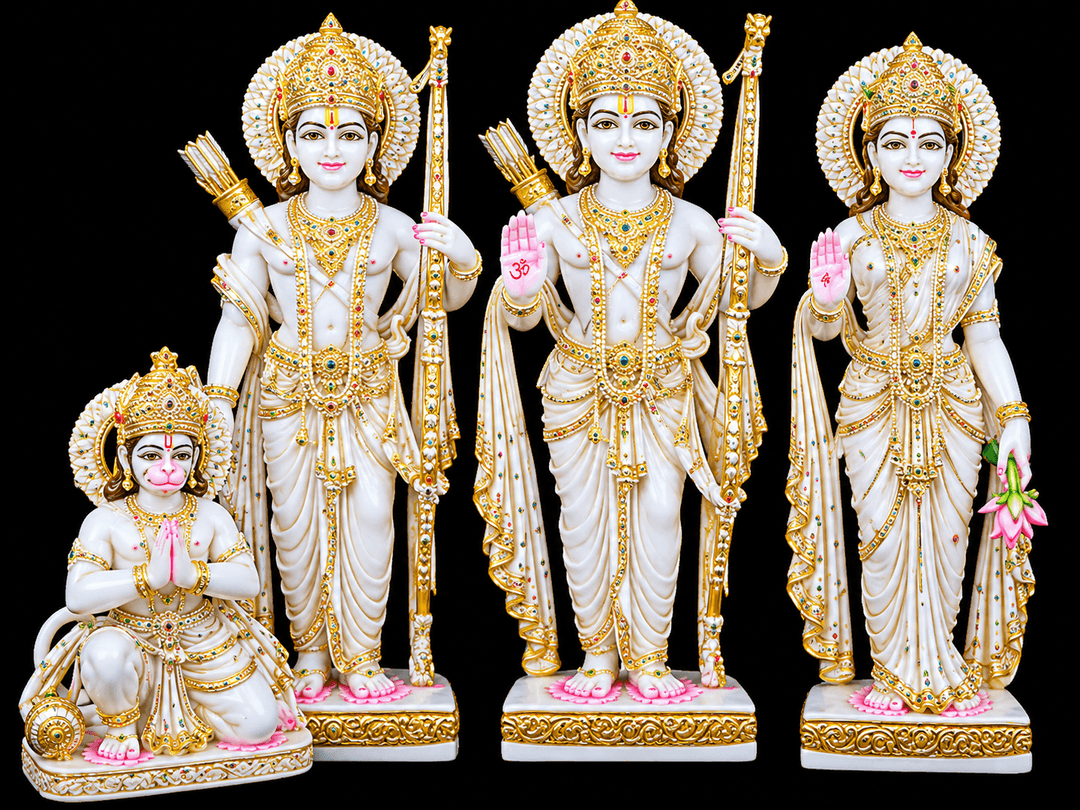
Marble Rama Sita Devotional Ensemble
Makrana MarbleSee photos & details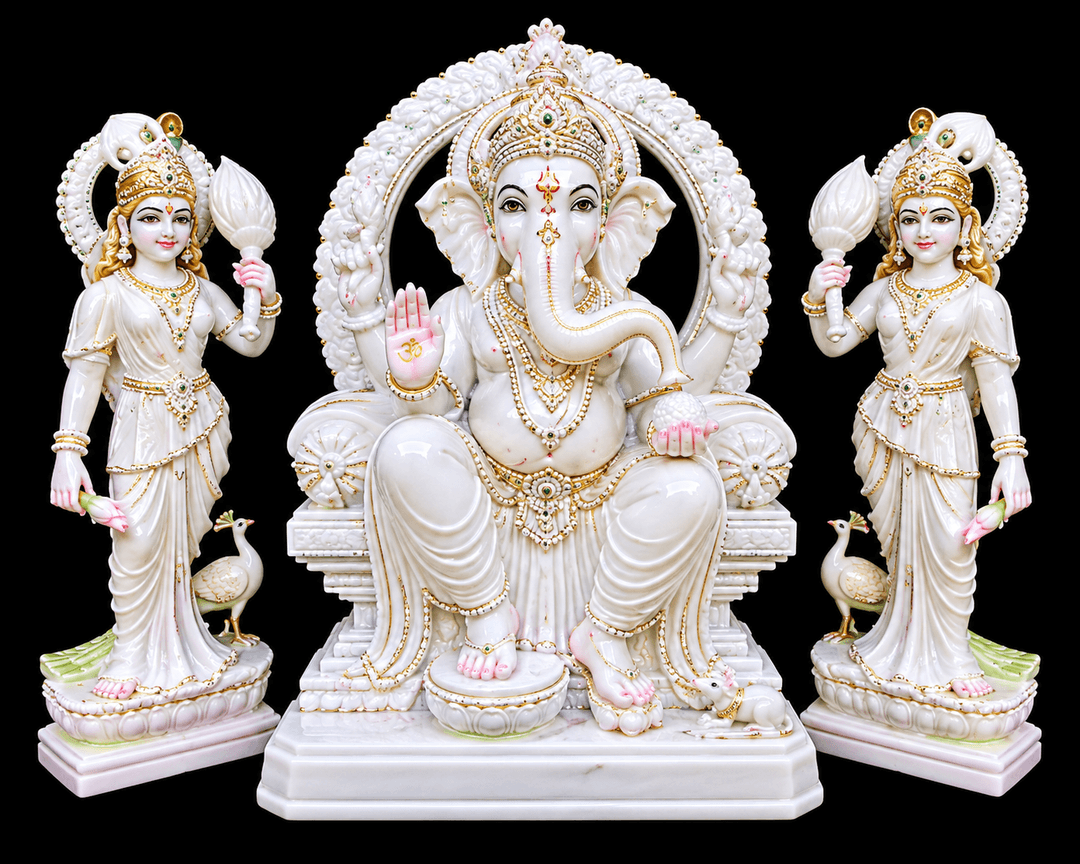
Ornate White Marble Ganesha Ensemble
Makrana MarbleSee photos & details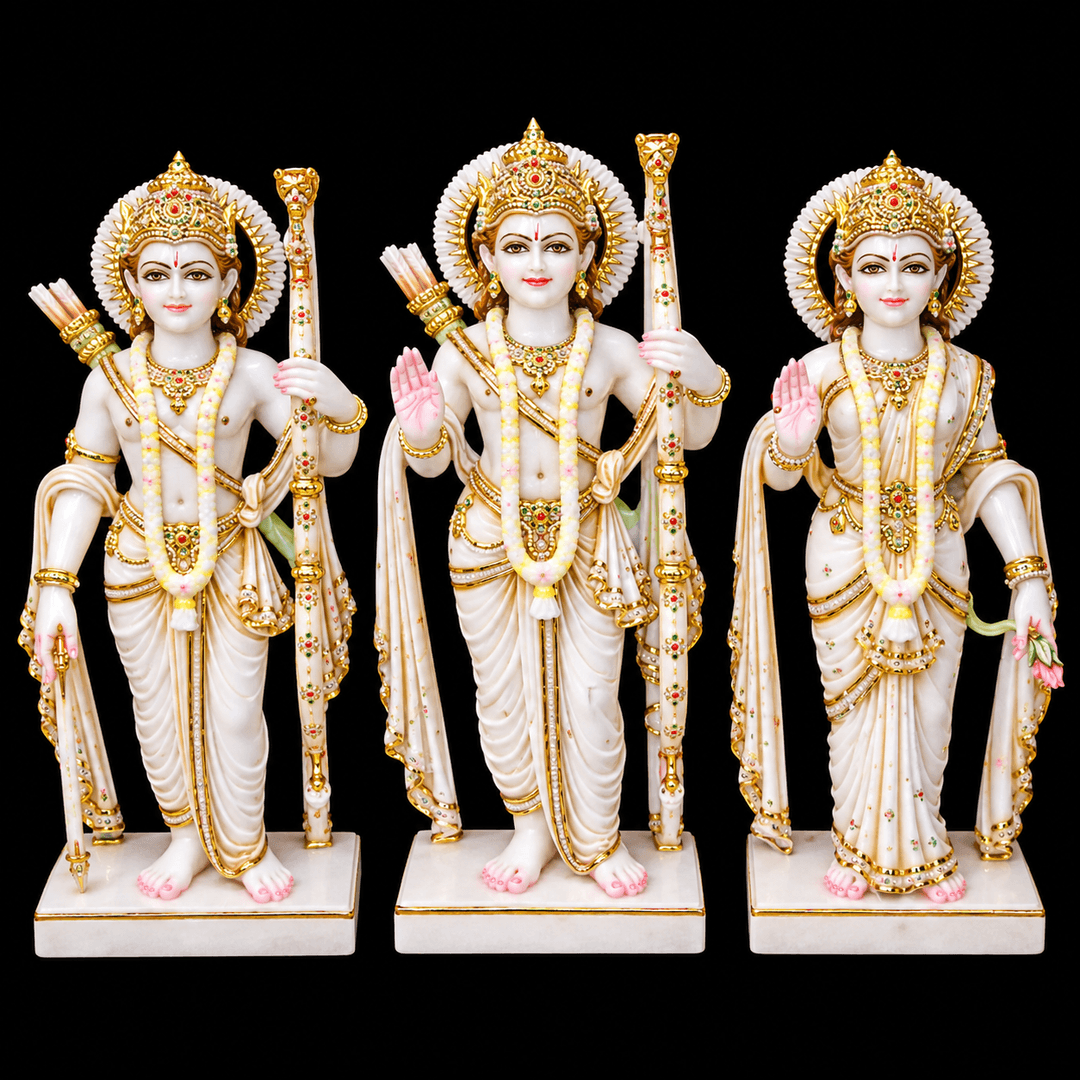
Ram Darbar Marble Statues Against Black
Makrana MarbleSee photos & details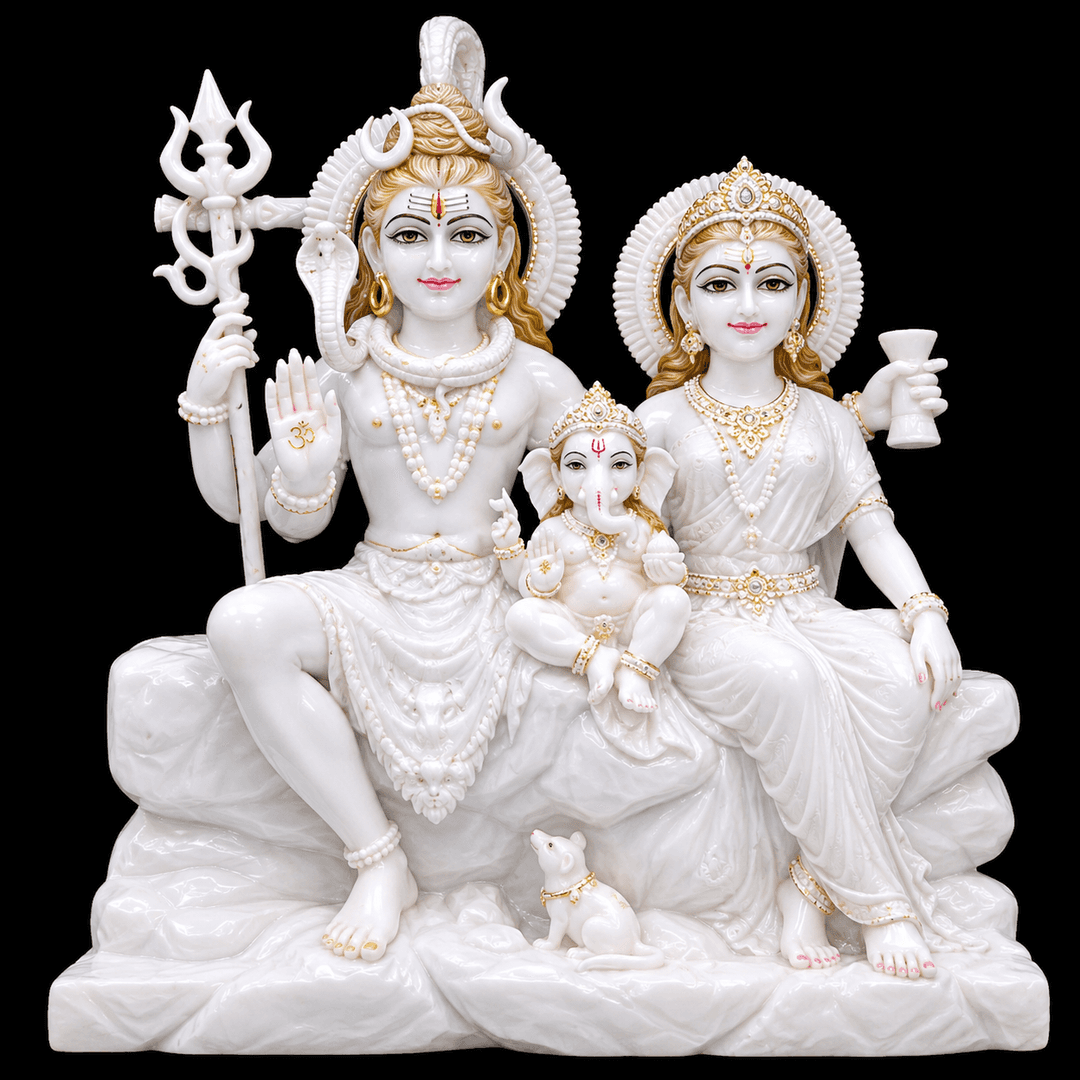
Shiva Parvati Ganesha Marble Family Statue
Makrana MarbleSee photos & details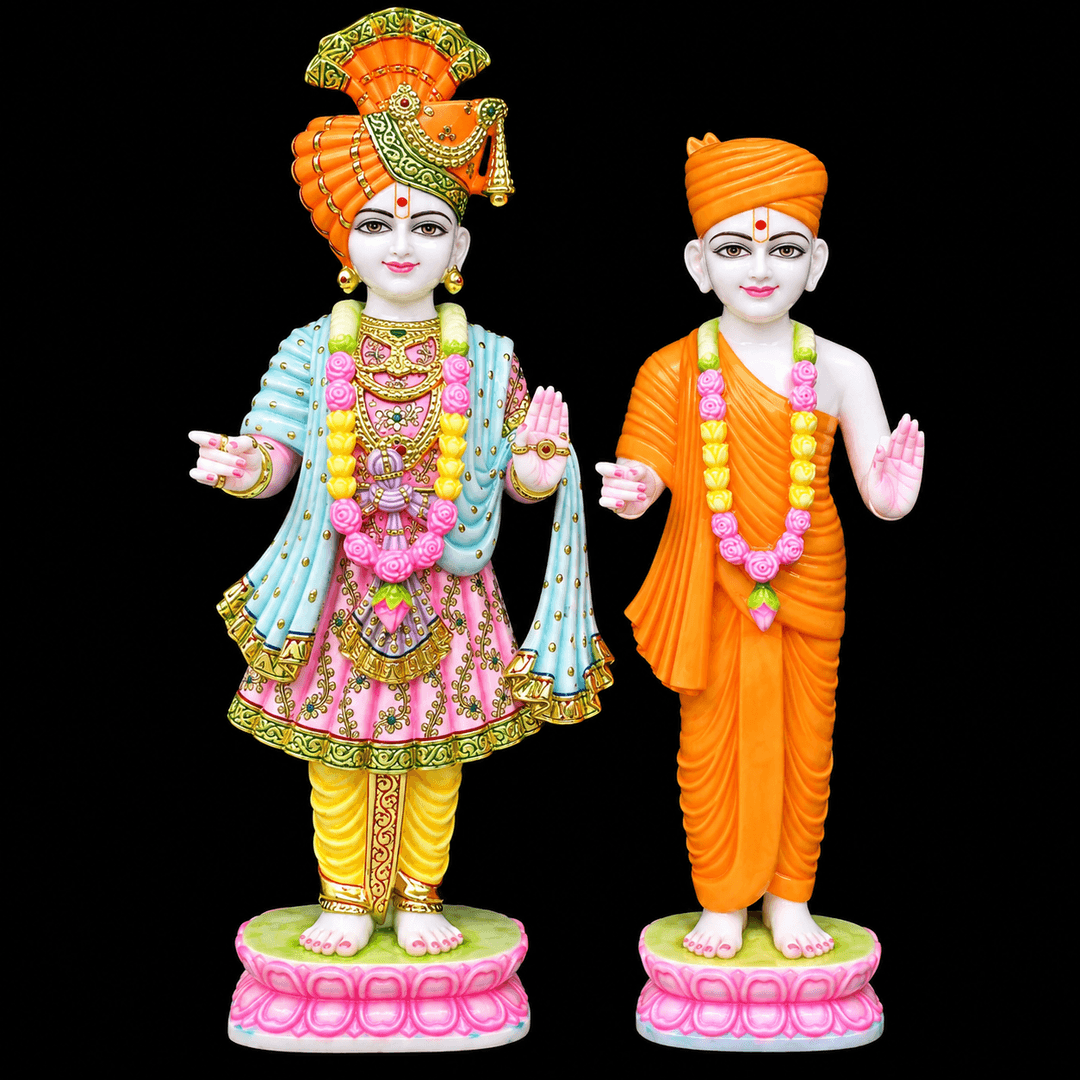
Twin Marble Deities on Lotus Pedestals
Makrana MarbleSee photos & details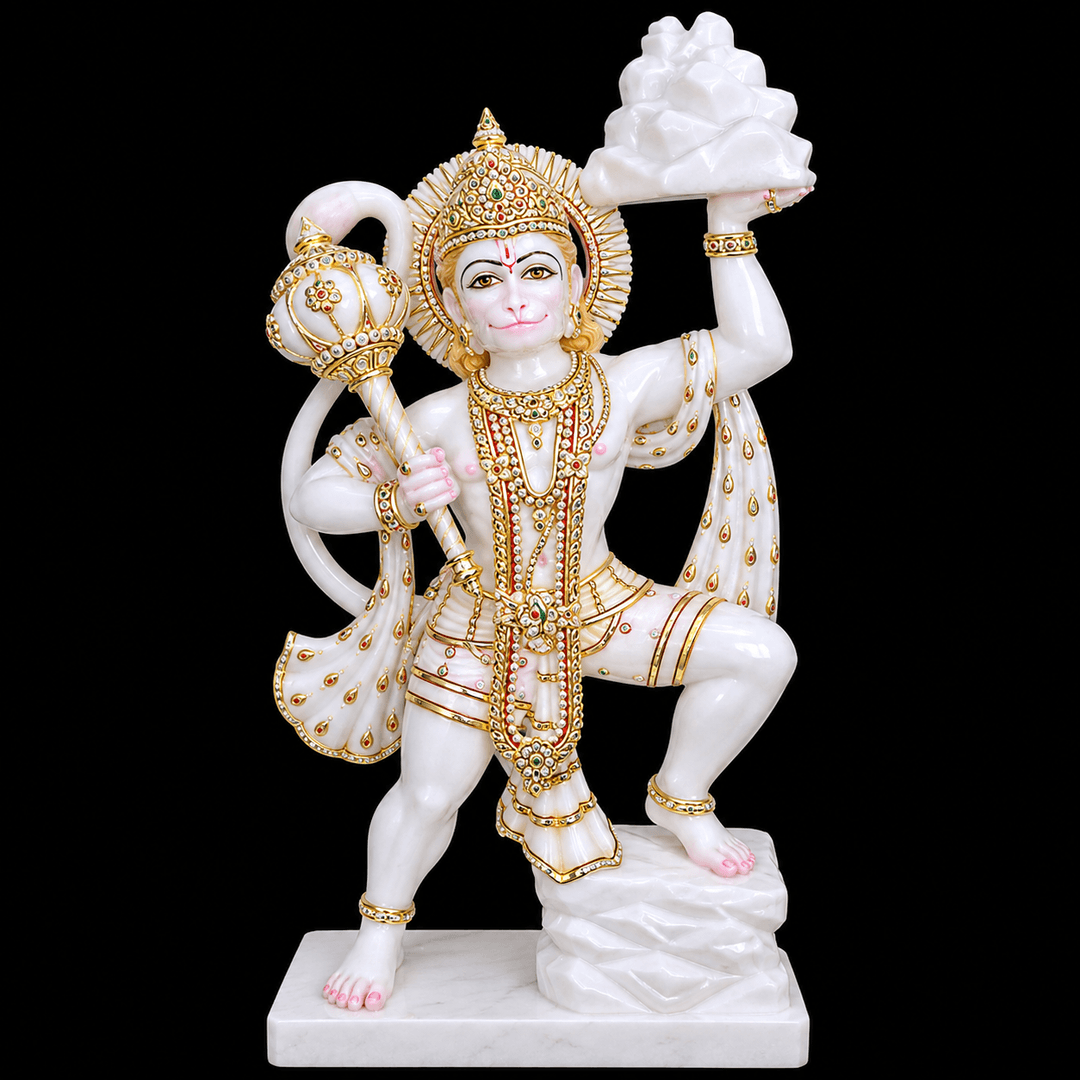
White Marble Hanuman with Golden Ornaments
Makrana MarbleSee photos & details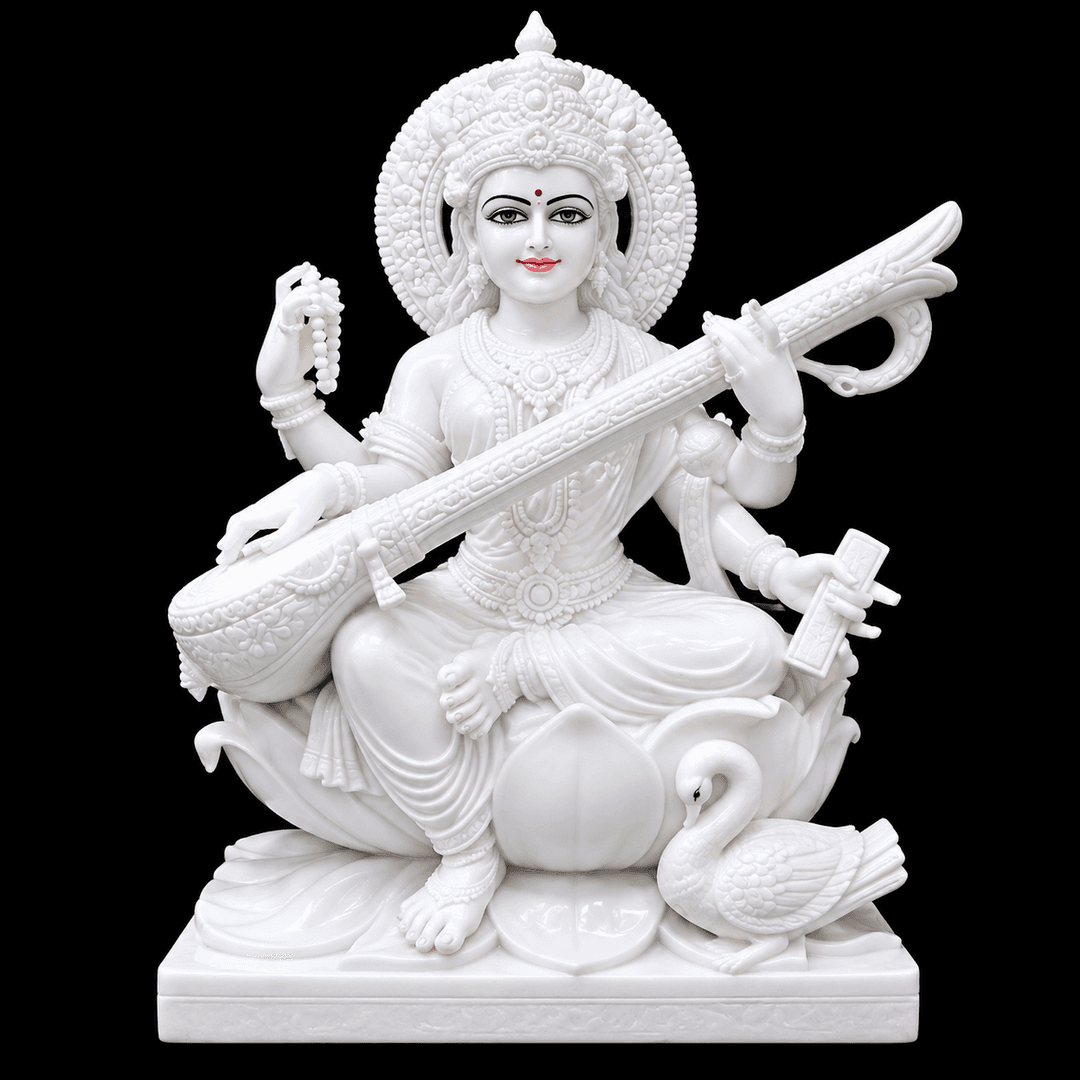
White Marble Saraswati with Veena
Makrana MarbleSee photos & details
- ◆ Since 1980
Third generation of one family, one address at Kookas, Jaipur.
- ◆ Your size
Every murti carved to order, 1 ft to 6 ft and larger.
- ◆ Your stone
Makrana, Rajasthani or Vietnam marble - you see the block.
- ◆ Across India
Crated and sent to your city; photos approved before dispatch.
The price depends on the size. So tell us the size.
Measure the place it will stand, choose the height, and send it. A person who carves them replies with a firm price in the stone you choose - usually the same working day. No obligation, no price list to decode.
Which corner the mandir takes
The north-east, the ishan corner, is the one vastu gives to the mandir, and the east and north walls are the next choice. The reasoning is light: the morning sun reaches that corner first, and a puja done in the morning is done facing it. The places to avoid are the ones custom and common sense agree on: directly under a staircase, against a wall shared with a toilet or a bathroom, in a basement, and in a bedroom if any other room is possible. If the only room is the bedroom, a mandir with doors that close, placed so the feet do not point at it, is the usual compromise.
Which way the murti looks
The rule most often given is that the worshipper should face east or north while praying, which means the murti faces west or south. In practice, in an ishan mandir, the murti faces west and you face east, and that is the arrangement in most homes. A murti facing east, so that you face west, is also accepted and is common in temples. Two murtis should not be set facing each other across the mandir. Hanuman is the exception people ask about: he is often placed facing south, the direction he guards, and a Hanuman on the south wall of a mandir looking north into the room is also common.
How high, and on what
Not on the floor. A murti stands on a chowki, a shelf or the pedestal of the mandir, and the usual height is such that the deity’s face is at or a little above your eye level when you sit to pray, and not above your head when you stand. For a mandir cabinet that means the main murti on the middle shelf, not the top. The surface should be level and firm; a marble murti is heavy and a shelf that flexes will, in time, let it rock.
What to keep near, and what away
Near: a lamp, placed so its heat does not touch the stone; water; the murti’s own vastra and asan. Away: photographs of the departed, which custom keeps in another room; broken or chipped murtis, which are repaired or respectfully retired, not kept in the mandir; and the mandir’s own clutter, old garlands and spent incense, which is cleared daily. A murti is not kept in the kitchen except where there is no other place, and then away from the stove.
One foot to six, and to order beyond.
Every murti here is quoted from one price sheet, in one-foot steps. Measure the place it will stand - the inside of the mandir, the niche, the plinth - and tell us the height. We reply with a firm price in the stone you choose, and a date.
Send the size- 1 ft
- Mandir cabinet, shelf, desk
- 2 ft
- Pooja room, entrance niche
- 3 ft
- Large home temple, hall, garden
- 4-6 ft
- Temple sanctum, facade, courtyard
Warm white, tight grain - the finest faces; the stone of the Taj.
Pieces in this stoneSofter white with a faint vein, large blocks, the look of the old temple murti.
Pieces in this stoneCool, uniform, translucent - for large flawless pieces.
Pieces in this stoneQuestions, answered.
What people ask before they buy. If yours is not here, the form is one tap away.
Which direction should a marble murti face at home?
Most commonly west, so that you face east while praying; facing east, with you facing west, is also accepted. Avoid two murtis facing each other. Follow your purohit if the advice differs.
Which direction should a Hanuman murti face?
Hanuman is usually set facing south, or on the south wall of the mandir looking into the room. Either is common.
Can I keep a marble murti in the bedroom?
Custom prefers another room. If the bedroom is the only place, use a mandir with doors that close and place it so the feet do not point towards it while sleeping.
How high should the murti be placed?
On a chowki or shelf, so the deity’s face is at or just above your eye level when seated. Never directly on the floor, and not above your standing head height.
Which corner is best for a pooja room?
The north-east, then the east or north. Avoid under the stairs, next to a toilet wall, and in a basement.
Kookas, on the Delhi-Jaipur Expressway.
Three generations of the Sharma family have carved marble at the same address since 1980 - NH-11C, Kookas, twenty minutes past Amer on the road to Delhi. Open every day, 10 AM to 10 PM. Come and see the stone, or write and we bring it to you by photograph.
Tell us the size.
We'll tell you the price.
A person who carves them reads every message, usually the same day. No phone calls unless you ask for one.
Ask about vastu & placement